

Ever seen someone comment “bro is glazing” under a video and wondered what on earth they meant? You’re definitely not alone. Internet slang changes quickly, and glaze meaning slang is one of those expressions that can sound completely confusing if you take it literally.
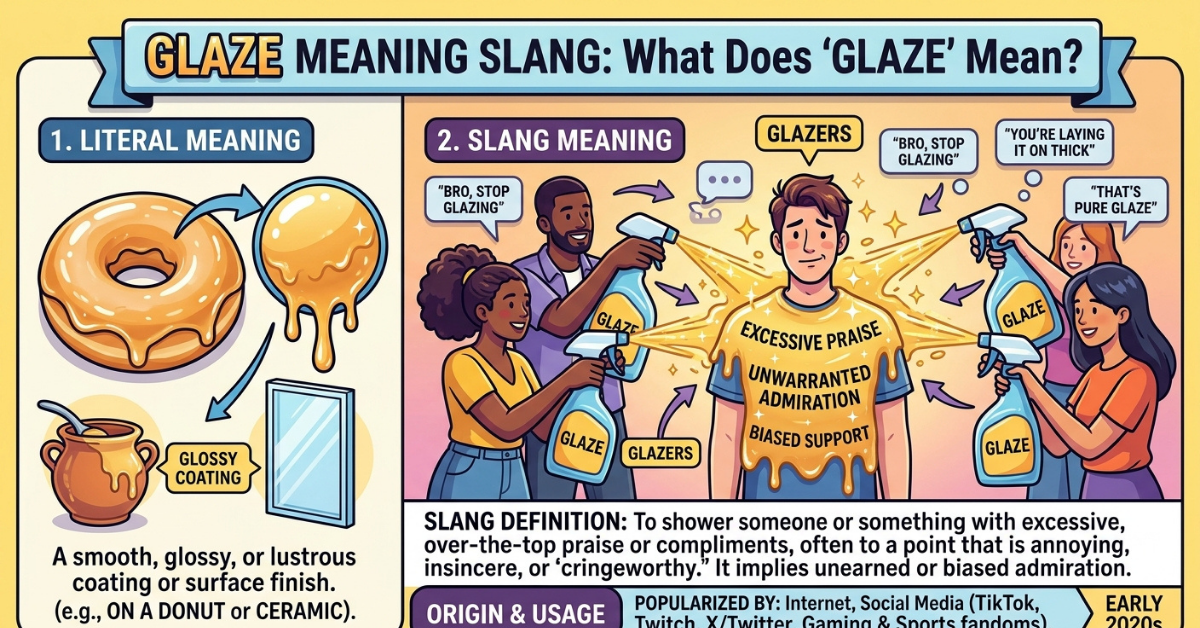
In online conversations, glaze usually means giving someone excessive praise, attention, or compliments, especially when the praise seems exaggerated or unnecessary. It is often used jokingly to call out someone who appears to be praising another person way too much.
The word is especially common on TikTok, Twitch, YouTube, X, gaming communities, and other social platforms. Let’s break down what it means, where it came from, and how people actually use it.
What Is the Glaze Meaning Slang?
In slang, “glaze” means to praise, compliment, or hype someone excessively.
Imagine a friend saying:
“That guy is the greatest athlete ever. Nobody comes close. Everything he does is perfect.”
Someone might respond:
“Stop glazing him.”
The person isn’t necessarily saying the compliment is completely false. Instead, they’re suggesting that the praise has gone too far.
In simple terms:
Glazing = excessive praise or admiration, often to the point of sounding exaggerated.
The word can be used seriously, but it’s usually thrown around humorously online.
What Does “To Glaze” Mean in Slang?
To glaze someone means to praise them excessively or repeatedly.
For example:
- “Why are you glazing him so hard?”
- “She’s been glazing that celebrity all day.”
- “Bro won’t stop glazing his favorite player.”
Here, “glazing” isn’t referring to food, cooking, or a shiny coating. It’s internet slang describing over-the-top admiration.
Glaze Meaning Slang Example
A simple glaze meaning slang example can make the expression much easier to understand.
Imagine two people watching a basketball game.
Person A: “He made one good shot.”
Person B: “He’s the best player in the league. He’s unbeatable. He’s going to be a legend. Nobody plays like him.”
Person A: “Bro, stop glazing.”
The joke is that Person B has taken a normal compliment and turned it into extreme praise.
Another example:
“You don’t have to glaze your favorite streamer every time they go live.”
This means the speaker thinks the person praises the streamer too much.
Glaze Meaning Slang on TikTok
The glaze meaning slang TikTok users typically intend is the same basic idea: excessive praise or admiration.
TikTok helped popularize many internet expressions by allowing slang to spread rapidly through comments, memes, livestreams, and short videos. “Glazing” became particularly common when people reacted to celebrities, athletes, influencers, musicians, streamers, and fictional characters.
You might see comments such as:
- “The glazing is crazy.”
- “Bro is glazing again.”
- “Enough with the glaze.”
- “That’s some serious glazing.”
- “Why is everyone glazing him?”
The expression is often playful rather than genuinely insulting.
Why Is “Glazing” So Common on TikTok?
There are a few reasons:
- Comment culture: TikTok comments frequently turn ordinary moments into jokes and memes.
- Celebrity discussions: Fans naturally praise their favorite creators, athletes, and entertainers.
- Short-form humor: One word such as “glazing” can quickly communicate an entire reaction.
- Meme repetition: Slang spreads rapidly when users repeat it across videos and comment sections.
As a result, someone doesn’t necessarily have to be seriously overpraising another person for the word “glaze” to appear. Sometimes it’s simply used as a humorous exaggeration.
Glaze Meaning Slang Urban Dictionary
If you’ve searched for glaze meaning slang Urban Dictionary, you’re likely looking for the informal internet definition rather than the traditional dictionary meaning.
Urban Dictionary contains user-submitted definitions of slang, memes, and informal expressions. Definitions can vary because entries are created by individual users rather than a single official language authority.
In online slang, the common idea behind glazing is excessive praise, flattery, or admiration.
It’s worth remembering that slang dictionaries can contain multiple definitions, jokes, offensive material, or outdated meanings. So context matters when interpreting a particular use.
The Glaze Meaning Slang
When someone says “the glaze”, they’re usually talking about the excessive praise itself.
For example:
“The glaze in these comments is unreal.”
This means there are lots of exaggerated compliments in the comments.
Similarly:
“I can’t handle the glaze.”
This suggests that someone thinks the amount of praise has become ridiculous or funny.
What Does “Glazer” Mean?
A glazer is someone who frequently or excessively praises another person.
For example:
“He’s such a glazer for that football player.”
The speaker is basically saying that the person is an overly enthusiastic fan.
The term can be used jokingly between friends, especially when someone becomes overly passionate about a favorite celebrity, athlete, team, streamer, or fictional character.
W Glaze Meaning Slang
The phrase “W glaze” combines “W” with “glaze.”
Online, W commonly means something positive, such as “win” or approval. So “W glaze” can be used humorously to approve of someone’s praise or to describe particularly strong glazing.
For example:
“That speech was incredible.”
“W glaze.”
Depending on the context, it can be sincere, sarcastic, or simply a meme-like response.
Because internet slang is highly context-dependent, the tone of the surrounding conversation matters.
No Glaze Meaning Slang
“No glaze” generally means “I’m not exaggerating” or “I’m being completely honest with this compliment.”
For example:
“No glaze, that’s one of the best songs I’ve heard this year.”
The speaker is emphasizing that they’re not simply overpraising the artist.
In other words:
No glaze = no exaggeration, no unnecessary praise, or genuinely speaking my mind.
It’s often used before or after a compliment to make the speaker sound more sincere.
Self Glaze Meaning Slang
Self glaze refers to excessively praising yourself or boasting about your own abilities.
For example:
“Bro is self-glazing again.”
This might be said when someone keeps talking about how talented, attractive, successful, or intelligent they are.
Self-glazing can overlap with concepts such as:
- Bragging
- Self-praise
- Boasting
- Showing off
- Self-promotion
However, “self-glaze” is usually more humorous and informal than these traditional terms.
Holy Glaze Meaning Slang
“Holy glaze” is an exaggerated reaction to someone praising another person excessively.
For example:
“Holy glaze, you’d think he invented basketball.”
The speaker is joking that the praise has reached an extreme level.
The word “holy” adds emphasis, much like saying:
- “Wow!”
- “That’s extreme!”
- “This is ridiculous!”
So holy glaze basically means an unusually intense amount of praise.
Glaze Meaning Slang Origin
The exact glaze meaning slang origin is difficult to pin down to one person, video, or date.
Like many internet slang terms, “glazing” developed through online communities and gradually became more widespread. It has been associated with gaming, livestreaming, sports discussions, social media, and meme culture.
The slang use should also be separated from the ordinary English meanings of glaze, which include coating something with a glossy substance or covering food with a sweet or shiny coating.
The modern slang sense is a metaphorical development rather than the literal culinary meaning.
As social platforms grew, users began using “glazing” as a humorous way to describe someone who was metaphorically “coating” another person with compliments.
There isn’t one universally accepted origin story, so claims that identify one exact creator or moment should be treated cautiously.
Is “Glaze” an Insult?
Not necessarily.
Calling someone a “glazer” can be teasing, sarcastic, critical, or completely playful depending on the situation.
For example:
Playful:
“Bro, you’re glazing Messi again”
Critical:
“Stop glazing the company. They clearly made a mistake.”
Sarcastic:
“Wow, what an amazing performance. Absolutely perfect. No mistakes whatsoever.”
“That’s some serious glaze.”
The relationship between the speakers and the tone of the conversation make a big difference.
Glaze Meaning Slang Synonyms
There isn’t one perfect synonym for “glaze,” but several words express a similar idea.
Some common glaze meaning slang synonym options include:
- Hype – strongly promote or praise someone.
- Simp – sometimes used for excessive admiration or devotion, although it has a different meaning and can be insulting.
- Dickride – vulgar slang for excessively supporting or praising someone.
- Flatter – praise someone, usually in a more traditional sense.
- Praise – express approval or admiration.
- Bootlick – show excessive admiration toward someone perceived as powerful, often with a negative meaning.
- Fanboy/fangirl – someone extremely enthusiastic about a person or thing.
The closest synonym depends heavily on context. “Praise” is neutral, while some slang alternatives can be much harsher.
How to Use “Glaze” in a Sentence
Here are several natural examples:
- “Stop glazing him; he isn’t that good.”
- “The comments are full of glaze today.”
- “No glaze, that was actually an amazing performance.”
- “Why are you glazing your favorite streamer so much?”
- “Bro started self-glazing during the interview.”
- “Holy glaze, you’ve mentioned him five times already.”
- “W glaze, that was a pretty good compliment.”
The expression works best in casual online conversations rather than formal writing.
Glazing vs. Genuine Compliment: What’s the Difference?
This is where context becomes important.
A genuine compliment is usually specific and reasonable:
“She played really well in that match.”
Glazing pushes the praise much further:
“She’s the greatest player to ever exist, and nobody will ever come close.”
The difference isn’t always the amount of praise. It can also be about how exaggerated, repetitive, or disproportionate the praise feels.
Quick Comparison
| Expression | Meaning |
| Compliment | Reasonable praise |
| Hype | Strong enthusiasm or promotion |
| Glaze | Excessive or exaggerated praise |
| Self-glaze | Excessive praise of yourself |
| No glaze | Emphasizing that you’re being sincere |
| Glazer | Someone who praises excessively |
When Should You Avoid Using “Glaze”?
Because “glaze” is informal internet slang, it isn’t appropriate for every situation.
Avoid using it in:
- Formal business emails
- Academic assignments
- Professional reports
- Official documents
- Formal interviews
You can use it comfortably in casual conversations, social media comments, gaming chats, memes, and messages with friends.
If you’re writing professionally, words such as praise, excessive admiration, flattery, or exaggerated approval are usually better choices.
Why Internet Slang Keeps Changing
“Glaze” is a good example of how language evolves online.
Social media users constantly shorten phrases, repurpose existing words, and turn ordinary vocabulary into memes. Once an expression becomes popular, its meaning can spread across different communities and sometimes change along the way.
That’s why slang rarely behaves like a traditional dictionary definition.
A word can be:
- Serious in one conversation
- Sarcastic in another
- A meme somewhere else
- Completely misunderstood outside the community
Understanding the context is therefore just as important as knowing the definition.
Frequently Asked Questions About Glaze Slang
What does glaze mean in slang?
In slang, glaze generally means to excessively praise, compliment, or admire someone, often in a way that seems exaggerated.
What does glazing mean on TikTok?
On TikTok, glazing usually refers to someone giving another person excessive praise or admiration. It is commonly used as a humorous comment or reaction.
What does “stop glazing” mean?
“Stop glazing” means stop praising or hyping that person so much. It can be serious, but it is often said jokingly.
What does “no glaze” mean?
“No glaze” generally means “I’m not exaggerating” or “I’m being genuinely honest.” It is often used before a strong compliment.
What does “W glaze” mean?
“W glaze” is a playful phrase combining “W,” meaning approval or a win, with “glaze.” It can humorously approve of or acknowledge someone’s praise.
What does “self-glaze” mean?
Self-glaze means excessively praising yourself, bragging about yourself, or repeatedly highlighting your own achievements.
What does “holy glaze” mean?
Holy glaze is an exaggerated way of pointing out that someone is praising another person an unusually large amount.
Is glazing the same as simping?
Not exactly. The words can overlap, but glazing specifically focuses on excessive praise or admiration, while “simping” can refer more broadly to excessive devotion or submissive behavior toward someone.
Is glaze a bad word?
“Glaze” itself isn’t inherently a bad word. However, some related slang expressions can be vulgar or insulting. The meaning and tone depend on how the word is being used.
What is a synonym for glaze slang?
Depending on the context, similar terms include hype, excessive praise, flattery, fanboying, or overpraising. Some stronger slang terms have additional meanings and may be offensive.
Final Thoughts on Glaze Meaning Slang
So, what is the glaze meaning slang? In today’s internet language, glaze, glazing, and glazer generally describe excessive praise, admiration, or hype directed toward someone.
You’ll most often encounter the expression on TikTok, gaming communities, livestreams, sports discussions, and meme-heavy social media conversations. Phrases such as “stop glazing,” “no glaze,” “W glaze,” “holy glaze,” and “self-glaze” are simply different ways of playing with the same basic idea.
The important thing is context. Sometimes “glazing” is a genuine criticism of excessive praise; other times, it’s nothing more than a joke between friends.
If you’re interested in decoding more internet slang, exploring related expressions can make social media conversations much easier to understand—and a lot less confusing.
Leave a comment