

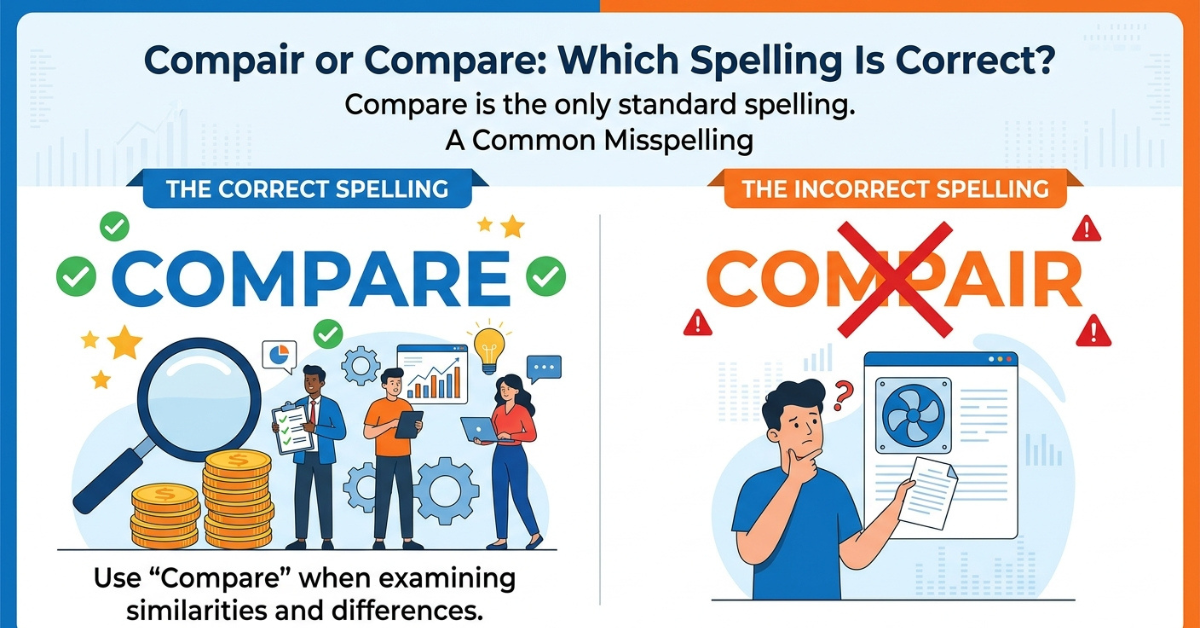
Have you ever typed “compair or compare” and stopped to wonder which spelling is actually correct? You’re not alone. English has plenty of words that sound different from how they are spelled, and compare can easily cause confusion because of its pronunciation.
The correct spelling is compare. Compair is a common spelling mistake, not the standard English spelling. In this guide, we’ll explain the compair or compare meaning, how to use compare correctly, and why the incorrect version is so easy to write.
Compair or Compare: Which Is Correct?
The correct spelling is compare.
- Compare — correct
- Compair — incorrect
The word compare is a verb that means to examine two or more people, things, ideas, or situations to identify their similarities and differences.
For example:
We need to compare the two designs before making a final decision.
You may see compair online, but it is generally a spelling error caused by the way compare sounds when spoken.
Compair or Compare Meaning
If you’re searching for the compair or compare meaning, you’re most likely trying to understand whether compair is a separate English word.
It isn’t the standard spelling. The word you’re looking for is compare.
Compare means to look at two or more things carefully and consider how they are similar or different.
Examples of compare in a sentence
Here are a few everyday examples:
- Let’s compare these two phones before buying one.
- The teacher asked students to compare the two poems.
- You can compare prices online to find a better deal.
- She compared the original drawing with the final design.
- Don’t compare your progress with someone else’s.
In each example, compare involves examining things in relation to one another.
Why Do People Spell Compare as Compair?
The confusion usually comes from pronunciation.
Compare is pronounced roughly like kuhm-PAIR, with the final sound resembling the word pair. Because of this, someone unfamiliar with the spelling may naturally write compair instead of compare.
This is an example of a spelling mistake based on sound. English has many words where pronunciation does not make the correct spelling obvious.
For example:
- pair and pear sound alike but have different meanings.
- there, their, and they’re sound similar but are used differently.
- right and write have the same pronunciation but different meanings.
Similarly, compare sounds as though it could end in -pair, but the correct spelling uses -pare.
What Does Compare Mean?
The word compare generally means to examine two or more things to see how they are alike or different.
It can be used in several contexts, including:
Comparing people
You might compare two athletes based on their performance, experience, or achievements.
Example:
People often compare the two players because they have similar playing styles.
Comparing products
Consumers often compare products before making a purchase.
Example:
I compared three laptops before choosing the one that suited my needs.
Comparing ideas
You can also compare opinions, theories, or concepts.
Example:
The essay compares traditional and modern approaches to education.
Comparing experiences
The word can describe personal experiences as well.
Example:
We compared our experiences of studying abroad.
Compare vs. Comparison
Although compare and comparison are closely related, they have different grammatical roles.
Compare is usually a verb.
Let’s compare these two options.
Comparison is a noun.
The comparison between the two options was helpful.
Other related words include:
- Compared — past tense or past participle of compare
- Comparing — present participle
- Comparable — similar enough to be compared
- Comparatively — in relation to something else
Understanding these related forms can make it easier to use compare correctly.
How to Use Compare Correctly
The verb compare is commonly followed by with or to, depending on the context.
Compare with
Compare with is often used when examining two things to identify similarities and differences.
Example:
Compare this year’s sales figures with last year’s figures.
Compare to
Compare to is often used when one thing is described as similar to another, especially when making an analogy or emphasizing a resemblance.
Example:
The author compared the city to a living organism.
In everyday English, however, the distinction can be flexible, and both constructions are widely used.
Common Mistakes With Compare
Knowing the correct spelling is only part of using the word properly. Here are some common mistakes to avoid.
1. Writing “compair”
This is the most obvious mistake.
Incorrect: Compair the two options.
Correct: Compare the two options.
2. Confusing compare with contrast
Although the words are related, they aren’t identical.
Compare looks at similarities and differences.
Contrast focuses mainly on differences.
For example:
The report compares the two companies.
This could involve both their similarities and differences.
The report contrasts the two companies.
This places greater emphasis on how they differ.
3. Using comparison when you need a verb
Because comparison is a noun, it cannot always replace compare.
Incorrect: Let’s comparison these products.
Correct: Let’s compare these products.
Compare Synonyms
If you’re writing an essay, article, report, or everyday message, you may want alternatives to compare.
Depending on the context, possible synonyms include:
- Examine
- Contrast
- Evaluate
- Assess
- Match
- Analyze
- Relate
- Consider
- Weigh
Keep in mind that these words don’t always have exactly the same meaning. Compare is usually the safest choice when you’re examining similarities and differences.
Compare in Everyday English
You probably use the idea of comparison more often than you realize.
You might:
- Compare two restaurants before choosing where to eat.
- Compare prices while shopping.
- Compare two interior designs for inspiration.
- Compare job offers before accepting one.
- Compare your current work with an earlier version.
- Compare two phones based on their features.
In all of these situations, the goal is to examine multiple options and understand how they relate to each other.
Easy Trick to Remember the Spelling
If you frequently confuse compair and compare, try connecting the word with another familiar word that contains -pare.
Think:
Compare → prepare → separate
These words all contain the spelling pattern -pare.
Another simple reminder is:
Compare has “pare,” not “pair.”
Although pair and pare can sound similar in some contexts, they have completely different spellings and meanings.
Compair or Compare: Quick Answer
If you need a quick answer, remember this:
| Spelling | Correct? | Meaning |
| Compare | Yes | To examine things for similarities and differences |
| Compair | No | Common spelling mistake |
| Comparison | Yes | The act or result of comparing |
| Comparable | Yes | Similar enough to be compared |
So, whenever you’re deciding between compair or compare, choose compare.
Frequently Asked Questions
Is “compair” a correct word?
No. Compair is not the standard English spelling. The correct word is compare.
What is the meaning of compare?
Compare means to examine two or more things to identify their similarities and differences.
Why do people write compair instead of compare?
The mistake usually happens because compare is pronounced with a sound similar to pair. People may spell the word according to how it sounds.
Is compare a verb or a noun?
Compare is primarily a verb. The related noun is comparison.
Example:
Let’s compare the two options.
The comparison was useful.
What is another word for compare?
Depending on the context, alternatives include contrast, examine, evaluate, assess, analyze, and match. However, each has slightly different uses.
What is the difference between compare and contrast?
Compare involves examining similarities and differences, while contrast usually focuses more specifically on differences.
Conclusion
When choosing between compair or compare, the answer is simple: compare is the correct spelling. Compair is a common spelling mistake that usually comes from the way the word sounds when spoken.
The compair or compare meaning is also straightforward: compare means to examine two or more things and consider their similarities or differences. Once you remember that the correct spelling contains -pare, not -pair, this common mistake becomes much easier to avoid.
If you’re working on your English vocabulary or spelling, learning small distinctions like this can make your writing clearer, more accurate, and more professional.
Leave a comment