

Have you ever seen someone reply “That’s cap” or end a message with “No cap” and wondered what they were talking about? If so, you’re not alone. The word cap has taken on a completely different meaning in modern internet slang.
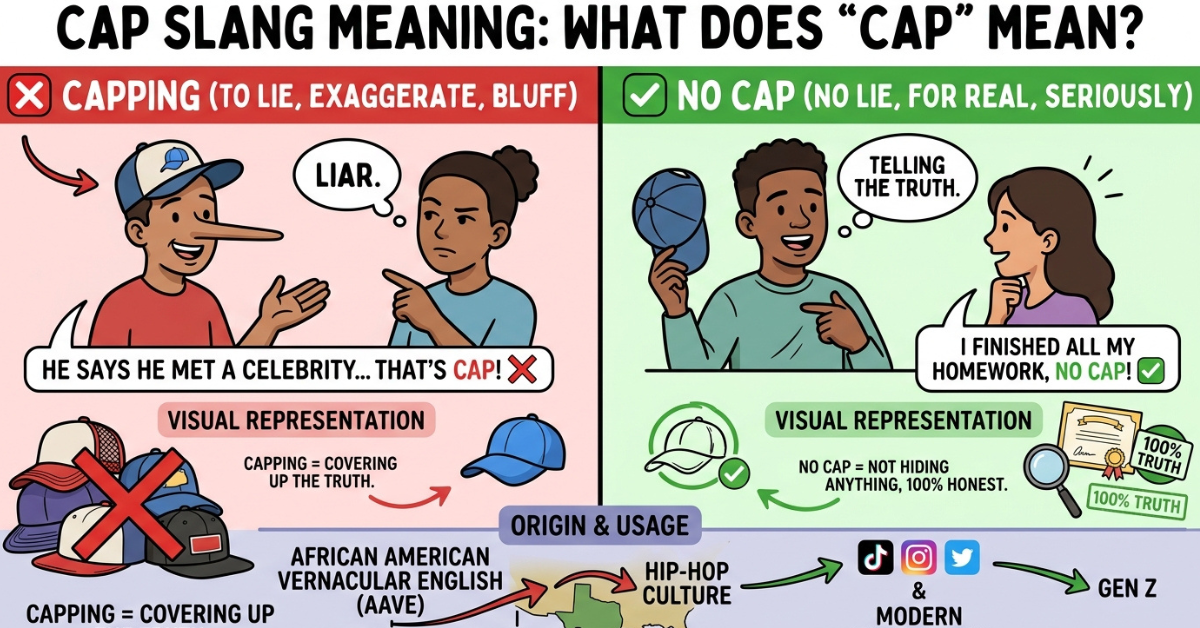
The cap slang meaning is usually connected to lying, exaggerating, or saying something that isn’t true. On the other hand, “no cap” means I’m telling the truth or I’m being completely serious. These expressions are especially common in texts, social media comments, memes, music, and casual conversations.
Let’s break down what cap really means, where the slang came from, and how to use it naturally.
What Is the Cap Slang Meaning?
In modern slang, cap means a lie, false statement, or exaggeration. When someone says that another person is “capping,” they usually mean that person isn’t being truthful.
For example:
“He said he owns three sports cars, but that’s cap.”
Here, the speaker believes the person is lying or exaggerating.
The word can be used as both a noun and a verb:
- Cap: A lie or false claim.
- Capping: Lying or exaggerating.
- To cap: To lie or make something up.
- No cap: Seriously, honestly, or without exaggeration.
So, when people search for the cap slang meaning definition, the simplest answer is: cap = a lie or something untrue.
What Does “No Cap” Mean in Slang?
“No cap” means “no lie,” “for real,” or “I’m telling the truth.”
It is often added to a sentence to emphasize that someone genuinely means what they are saying.
Examples of “No Cap”
- “That was the best burger I’ve ever had, no cap.”
- “I studied for eight hours yesterday, no cap.”
- “She is one of the nicest people I know, no cap.”
- “This movie was actually amazing, no cap.”
In each example, no cap tells the reader that the speaker isn’t exaggerating.
This is why the no cap slang meaning definition can be understood as “I’m being honest” or “I’m not lying.”
What Does “That’s Cap” Mean?
If someone says “That’s cap,” they’re basically saying “That’s a lie” or “I don’t believe you.”
For example:
Person A: “I finished the entire project in 20 minutes.”
Person B: “That’s cap.”
Person B is suggesting that Person A is exaggerating or not telling the truth.
The phrase can be serious, but it is often used playfully between friends.
What Does “Stop the Cap” Mean?
“Stop the cap” means “Stop lying,” “Stop exaggerating,” or “Be honest.”
For example:
“You didn’t really meet that celebrity. Stop the cap!”
It can also be used jokingly when someone makes an obviously exaggerated claim.
Similar expressions include:
- “Quit capping.”
- “You’re capping.”
- “That’s cap.”
- “No cap.”
- “Stop the cap.”
Cap vs. No Cap: What’s the Difference?
The easiest way to understand the slang is to look at the two expressions together.
| Expression | Meaning |
| Cap | A lie, exaggeration, or false claim |
| Capping | Lying or exaggerating |
| That’s cap | That’s a lie / I don’t believe that |
| Stop the cap | Stop lying or exaggerating |
| No cap | Honestly / for real / no lie |
| No cap, seriously | I genuinely mean this |
Think of it this way:
Cap = not telling the truth
No cap = telling the truth
Cap Slang Meaning in Texting and Social Media
The word cap is particularly common online. You might see it in TikTok comments, Instagram posts, YouTube comments, Snapchat messages, gaming chats, and text conversations.
For example:
- “Bro said he can run 10 miles. Cap.”
- “No cap, this is the funniest video ever.”
- “That’s cap and you know it.”
- “Why are you capping?”
- “Stop the cap.”
On social media, people sometimes use the cap emoji to mean lie or that’s not true.
Someone might simply comment:
Instead of writing “That’s a lie.”
Cap Slang Meaning: Origin and History
The modern slang meaning of cap is strongly associated with African American Vernacular English (AAVE) and Black American speech, particularly with the expression “capping.” It later spread widely through hip-hop, rap lyrics, social media, and internet culture.
The exact origin of the slang isn’t completely settled. However, cap and capping had already appeared in African American slang before becoming a mainstream internet expression.
One commonly discussed connection is the phrase “to cap” meaning to lie or exaggerate, while another theory connects the term with older expressions involving cap as something that covers or conceals the truth. The popular internet explanation that “cap” simply means “lie” is useful for understanding today’s usage, but the historical development is more complicated.
By the late 2010s, “no cap” became especially widespread in online culture and popular music.
Why Does “Cap” Mean Lie?
There isn’t one universally accepted explanation for exactly why cap came to mean lie. Slang often develops organically within communities, and words can acquire new meanings through music, conversation, and cultural trends.
Several explanations circulate online, but they shouldn’t all be treated as established facts.
The important point for everyday usage is straightforward:
When someone says “cap,” they are generally talking about dishonesty, exaggeration, or an unbelievable claim.
And when they say “no cap,” they’re emphasizing that they’re being genuine.
“Cap Cap” Slang Meaning
If you’ve seen someone write “cap cap”, the meaning depends heavily on context.
Repeating a slang word can simply add emphasis. For example:
“Nah, that’s cap cap.”
This could mean:
“That is definitely a lie.”
It isn’t a completely separate slang term with one fixed definition. The repetition mainly intensifies the original meaning.
“Cap” Has Other Meanings Too
Slang isn’t the only meaning of the word cap. Context matters.
1. Plastic Cap Meaning
A plastic cap is simply a small covering used to close a bottle, container, tube, or similar item.
For example:
- Water bottle cap
- Toothpaste cap
- Medicine bottle cap
- Pen cap
This has nothing to do with internet slang.
2. Nightcap Meaning
A nightcap traditionally refers to something associated with bedtime. Historically, it could mean a soft cap worn while sleeping.
The word can also refer to a drink taken shortly before going to bed.
So nightcap has a completely different meaning from internet slang such as “no cap.”
3. Cap as a Hat
In everyday English, a cap can simply mean a type of hat.
For example:
“He wore a baseball cap.”
Again, this is the ordinary dictionary meaning rather than slang.
What Does “Peel Your Cap” Mean?
“Peel your cap” is not a standard, widely established slang expression with one universal meaning. Its interpretation depends on where you encountered it.
It may be a creative phrase, regional expression, lyric, joke, or a variation of another expression. Therefore, it shouldn’t automatically be interpreted using the modern cap = lie meaning.
If you see “peel your cap” in a particular song, post, or conversation, the surrounding sentence is important for determining what the speaker intended.
What Does “Colonies Cap” Mean?
“Colonies cap” isn’t a standard English slang expression meaning “lie.” If you encountered this exact phrase online, it may be referring to something completely different, such as a product, clothing item, organization, historical reference, or a phrase used in a specific community.
This is a good example of why context matters when interpreting slang. Not every appearance of the word cap relates to “no cap” or “that’s cap.”
Cambridge and Merriam-Webster on “Cap” Slang
People often search for phrases such as “Merriam-Webster cap slang meaning lie” or “Cambridge no cap slang meaning.”
Major dictionaries increasingly document informal and slang uses of words because these expressions have become part of everyday communication. However, dictionary definitions should be distinguished from internet claims about a word’s supposed origin.
The safest takeaway is that contemporary slang cap can mean a lie or falsehood, while no cap is used to emphasize honesty or sincerity.
How to Use “Cap” Correctly
If you’re new to the slang, don’t overthink it. These simple patterns cover most everyday situations.
Use “cap” when you think someone is lying
“You said you ran 20 miles? That’s cap.”
Use “capping” when describing someone’s behavior
“He’s capping about his grades.”
Use “no cap” when emphasizing honesty
“No cap, this is the best pizza I’ve ever had.”
Use “stop the cap” when telling someone to stop exaggerating
“Stop the cap. We both know what happened.”
Examples of Cap Slang in Everyday Conversations
Here are a few natural examples:
Friend: “I can beat anyone at FIFA.”
You: “Bro, that’s cap.”
Friend: “I actually finished all my work before lunch.”
You: “No cap?”
Friend: “No cap.”
Friend: “I have a million followers.”
You: “Stop the cap.”
Friend: “This is honestly the best song I’ve heard all year, no cap.”
In casual conversations, these phrases are usually playful rather than formal accusations.
Is “Cap” a Bad Word?
No. Cap isn’t generally considered a swear word or profanity.
It is informal slang, though, so it may not be appropriate in every situation. Using it with friends or on social media is usually natural, but in a formal email, academic assignment, or professional report, it’s better to use standard language such as:
- Lie
- False claim
- Exaggeration
- Untrue statement
- Misleading statement
Is “No Cap” Still Used in 2026?
Yes, “no cap” remains recognizable slang in 2026, particularly online and in casual speech. However, slang changes quickly. Some people use it frequently, while others may consider it dated or simply use it jokingly.
That is normal for internet language. Expressions can move from niche communities into mainstream culture and eventually become less fashionable.
So if you’re wondering about the no cap slang meaning 2026, the meaning remains essentially the same:
No cap = honestly, seriously, or without lying.
Common Mistakes About Cap Slang
A few misunderstandings come up regularly.
Mistake 1: Thinking “cap” always means a hat
In ordinary English, yes, cap can mean a hat. But in social media slang, context may indicate the meaning lie or exaggeration.
Mistake 2: Thinking “no cap” means “no hat”
Usually, it doesn’t. In slang, no cap means no lie or I’m being serious.
Mistake 3: Assuming every “cap” phrase is slang
Not necessarily. Expressions such as plastic cap and nightcap have traditional meanings unrelated to internet slang.
Mistake 4: Treating slang origins as certain
The history of slang can be difficult to trace. Online explanations sometimes present theories as established facts when the evidence is less clear.
Frequently Asked Questions About Cap Slang
What does cap mean in slang?
In modern slang, cap means a lie, false statement, or exaggeration. Saying someone is “capping” means they are lying or exaggerating.
What does “no cap” mean?
“No cap” means “no lie,” “for real,” or “I’m telling the truth.” It is commonly used to emphasize sincerity.
What does “that’s cap” mean?
“That’s cap” means “That’s a lie” or “I don’t believe you.”
What does “stop the cap” mean?
“Stop the cap” means “stop lying” or “stop exaggerating.”
Where did cap slang come from?
The modern slang use of cap is closely associated with African American speech and AAVE and later became widespread through hip-hop, music, social media, and internet culture. Its precise etymology is debated.
Does cap mean lie?
Yes. In contemporary slang, cap can mean a lie or an exaggerated/untrue claim.
What does “capping” mean?
Capping means lying, exaggerating, or making an untrue claim.
What does the cap emoji mean?
The cap emoji is often used online to mean “lie,” “that’s not true,” or “you’re capping.”
Is “no cap” formal English?
No. No cap is informal slang, so it is best suited to casual conversations, texts, comments, and social media.
Does “cap” always mean lie?
No. Context matters. Cap can also mean a hat or a covering, while words such as nightcap have their own established meanings.
Final Takeaway
The simplest way to remember the cap slang meaning is this: cap = lie or exaggeration, while no cap = truth or honesty.
If someone says “That’s cap,” they don’t believe what was said. If they say “No cap,” they’re emphasizing that they’re serious and telling the truth. Meanwhile, phrases like “stop the cap” and “you’re capping” build on the same idea.
Slang changes constantly, but understanding these basic expressions makes social media posts, texts, memes, and casual conversations much easier to follow. If you’re exploring modern internet language, learning related slang terms can also help you understand how these expressions are used in different online communities.
Leave a comment