

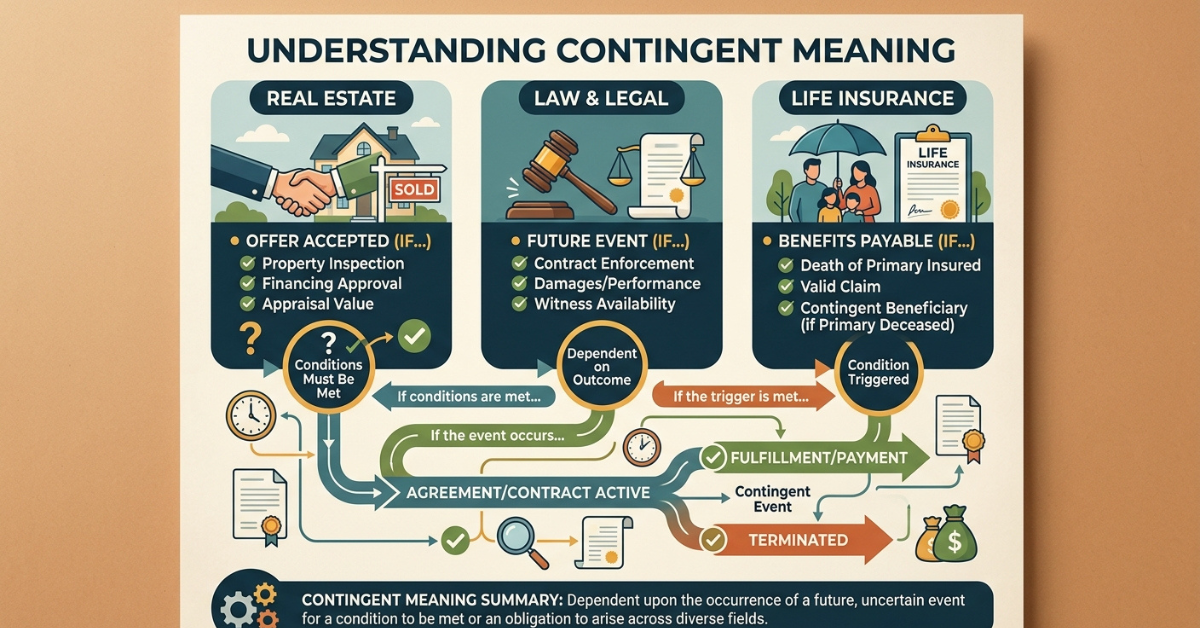
Have you ever looked at a house listing and wondered, “What does contingent mean?” You’re not alone. The word contingent appears in real estate listings, legal documents, contracts, insurance policies, and everyday conversations, but its meaning can change slightly depending on the context.
In simple terms, contingent meaning refers to something that depends on another event or condition happening first. If that condition is not met, the expected result may not happen.
For example, when a house is listed as contingent, the seller has generally accepted an offer, but the sale still depends on certain requirements being completed. In life insurance, a contingent beneficiary is someone who receives the policy benefit if the primary beneficiary cannot receive it.
So, what does contingent really mean? Let’s break it down in plain English.
What Is the Contingent Meaning?
The basic contingent meaning is dependent on a particular condition or future event.
Something described as contingent is not completely certain yet. It will happen only if a specific requirement is satisfied.
For example:
“The purchase is contingent on the buyer obtaining financing.”
This means the purchase can proceed if the buyer gets the required financing.
The word can be used in several areas, including:
- Real estate
- House sales
- Contracts
- Law
- Life insurance
- Beneficiary arrangements
- Business agreements
- Everyday decision-making
The common idea is always the same: one thing depends on another thing happening first.
The Legal Information Institute similarly defines contingent as something that may or may not happen depending on the fulfillment of an uncertain condition.
Contingent Meaning in Real Estate
The phrase contingent meaning in real estate is especially important for people searching for homes.
When a house is marked contingent, it usually means the seller has accepted an offer, but the transaction still has one or more conditions that need to be satisfied before the sale can move forward.
In other words, the house is under contract, but the deal is not completely finalized.
Common real estate contingencies include:
- Home inspection
- Mortgage or financing approval
- Appraisal
- Sale of the buyer’s existing home
- Title-related requirements
- Attorney review, depending on the location and contract
Zillow describes a contingent offer as one where the seller has accepted an offer but specific conditions still need to be met before closing.
Contingent Meaning on a House
So, what does contingent meaning on a house actually tell you?
It tells you that another buyer has usually made an offer that the seller accepted, but something still needs to happen before the transaction can be completed.
For example, imagine a house is listed for $400,000.
A buyer offers $400,000, and the seller accepts. However, the buyer’s mortgage approval is still pending.
The property could therefore be shown as contingent because the sale depends on that financing condition being satisfied.
This does not necessarily mean the home is sold.
The transaction can still fail if a required contingency is not satisfied, depending on the contract and applicable law.
Contingent Meaning House: Is the House Still for Sale?
This is one of the most common questions buyers have.
If a house is contingent, another buyer may already have a contract on it. However, the deal has not necessarily reached the final closing stage.
Whether you can make another offer depends on the listing status, the contract, local practices, and the seller’s willingness to consider backup offers.
Some contingent listings may still be shown to prospective buyers, while others may effectively be unavailable to new buyers.
That’s why it is worth speaking with the listing agent or your own real estate professional if you are seriously interested.
Contingent Meaning on a House for Sale
The contingent meaning on a house for sale is generally:
The seller has accepted an offer, but the sale is dependent on one or more conditions being completed.
For example, the buyer might need to:
- Complete a home inspection.
- Secure mortgage financing.
- Receive a satisfactory appraisal.
- Sell their current home.
- Complete another contractual requirement.
Until those conditions are resolved, the property may remain in a contingent status.
Realtor.com notes that contingencies can include inspection, appraisal, financing, title, and other requirements depending on the transaction.
Active Contingent Meaning
You may also come across the phrase active contingent while browsing property listings.
So, what does active contingent meaning refer to?
An active contingent listing generally indicates that an offer has been accepted with contingencies, while the listing can remain active in the marketplace under the applicable listing rules.
The exact meaning of listing statuses can vary between multiple listing services and markets, so “active contingent” should not be interpreted as a universal legal status.
Realtor.com explains that an active contingent home has an accepted offer with conditions that still need to be resolved, such as inspection, financing, or the buyer selling another property.
Can You Make an Offer on an Active Contingent House?
Sometimes, yes.
A buyer may be able to submit a backup offer or another offer depending on the seller’s situation and the applicable contract.
However, you should not assume that your offer will replace the existing buyer.
The first buyer generally has contractual rights that must be considered, and the seller cannot simply ignore those rights.
If you find a contingent property you really like, ask your Realtor:
- Is the seller accepting backup offers?
- What contingency is still outstanding?
- How long is the contingency period?
- Can I still schedule a viewing?
- What happens if the existing contract falls through?
Contingent vs. Pending: What’s the Difference?
Contingent and pending are not necessarily the same thing.
A contingent property generally has an accepted offer but still has conditions that need to be satisfied.
A pending property generally means the major contingencies have been met and the transaction is moving toward closing.
Zillow describes the distinction this way: a contingent sale remains conditional, while a pending sale generally indicates that the contingencies have been satisfied and the transaction is progressing toward closing.
| Status | General Meaning |
| Active | Property is generally available for offers |
| Contingent | Offer accepted, but conditions remain |
| Pending | Contingencies have generally been satisfied and closing is approaching |
| Sold/Closed | Transaction has been completed |
Keep in mind that listing terminology can differ between MLS systems and locations.
Common Types of Real Estate Contingencies
Understanding the specific contingency can tell you much more than simply seeing the word “contingent.”
1. Inspection Contingency
An inspection contingency gives the buyer an opportunity to have the property inspected.
If serious problems are discovered, the contract may allow the buyer to negotiate repairs, request concessions, or potentially terminate the agreement, depending on the contract.
2. Financing Contingency
A financing or mortgage contingency makes the purchase dependent on the buyer obtaining the necessary financing.
If financing cannot be secured under the terms and within the time allowed by the contract, the buyer may have contractual options.
3. Appraisal Contingency
An appraisal contingency can protect a buyer when the lender’s valuation comes in below the agreed purchase price.
For example, suppose a buyer agrees to pay $500,000, but the property is appraised at $470,000.
The buyer and seller may then need to renegotiate, the buyer may need to contribute additional funds, or the buyer may have other contractual options.
4. Home Sale Contingency
This is sometimes called a sale-of-home contingency.
It means the buyer’s purchase depends on selling their existing property.
For someone who needs money from their current home to finance the next one, this contingency can be extremely important.
5. Title Contingency
A title-related contingency can address issues involving ownership, liens, or other title concerns that need to be resolved before closing.
The specific rights and procedures depend on the purchase contract and local law.
What Does Contingent Mean on Zillow?
If you’re searching for contingent meaning Zillow, the basic idea is straightforward.
A contingent Zillow listing generally indicates that the seller has accepted an offer, but the sale remains subject to certain conditions.
Zillow distinguishes contingent from pending because a contingent transaction still has conditions that need to be resolved.
However, don’t assume that every Zillow listing status has exactly the same practical meaning everywhere.
Listing data comes from real estate sources and MLS systems, and terminology can vary by market.
Zillow Contingent Meaning vs. Pending
If you see:
Contingent:
An accepted offer exists, but one or more conditions remain.
Pending:
The transaction has generally moved further along, with contingencies satisfied or otherwise resolved.
That distinction can help you decide whether it is worth contacting an agent about the property.
Contingent Meaning Realtor: What Does a Realtor Mean by It?
When a Realtor says a property is contingent, they’re usually referring to an accepted offer that is still subject to specific contractual conditions.
For example, a Realtor might say:
“The home is contingent on the buyer selling their current house.”
That means the existing buyer’s purchase depends on selling their other property.
A Realtor can also tell you exactly which contingency applies and whether the seller is willing to consider backup offers.
Because real estate contracts are legally binding documents, the actual contract—not simply the listing label—is what determines the parties’ rights and obligations.
Contingent Meaning Beneficiary
The word contingent has another important meaning when discussing beneficiaries.
A contingent beneficiary is someone who receives an asset or benefit if a specified condition occurs, commonly if the primary beneficiary is unable to receive the benefit.
This concept is frequently used in life insurance and estate planning.
For example:
- Primary beneficiary: Your spouse
- Contingent beneficiary: Your child
If the primary beneficiary dies before you, the contingent beneficiary may become entitled to the policy proceeds, subject to the policy terms and applicable law.
The National Association of Insurance Commissioners explains that a contingent beneficiary, also called a secondary beneficiary, receives life insurance proceeds if the primary beneficiary dies before the policyholder.
Contingent Meaning in Life Insurance
The contingent meaning in life insurance is closely connected to beneficiary planning.
When you purchase life insurance, you generally name one or more beneficiaries who should receive the policy’s death benefit.
A primary beneficiary is first in line to receive the benefit.
A contingent beneficiary is generally next in line if the primary beneficiary cannot receive it under the policy’s terms.
Example of a Contingent Beneficiary
Imagine that Sarah purchases a life insurance policy.
She names:
- Her husband as the primary beneficiary
- Her daughter as the contingent beneficiary
If her husband dies before Sarah and is therefore unable to receive the benefit, her daughter may become entitled to the proceeds according to the policy.
This is why keeping beneficiary designations up to date matters. Major life events such as marriage, divorce, births, or deaths can make an old beneficiary designation inappropriate.
Beneficiary Contingent Meaning in Simple Words
If you’re searching for beneficiary contingent meaning, think of it as:
“The backup person who may receive the benefit if the primary beneficiary cannot.”
A contingent beneficiary is therefore similar to having a second option in place.
It does not necessarily mean that the contingent beneficiary will receive anything. Their entitlement depends on what happens to the primary beneficiary and on the terms of the relevant policy, will, trust, or other legal arrangement.
Contingent Meaning in Law
The contingent meaning in law is broader than its real estate use.
In legal contexts, contingent generally describes a right, obligation, interest, or event that depends on an uncertain future condition.
For example, a legal document might provide that someone receives property if a particular event occurs.
That person’s interest can be described as contingent because the benefit depends on satisfying the condition.
The Legal Information Institute uses examples involving contingent ownership and contingent interests, where rights arise only if a specified condition occurs.
Contingent vs. Vested
One useful legal distinction is between contingent and vested.
- Contingent: Depends on an uncertain condition or event.
- Vested: The right or interest has become established and is not dependent on that same uncertain condition.
This distinction can become complicated in property, inheritance, trust, and estate law, so the exact meaning depends on the document and the jurisdiction involved.
Contingent Meaning in Everyday English
Outside of real estate, insurance, and law, contingent simply means dependent on something else.
Here are a few examples:
“Our trip is contingent on the weather.”
Meaning: We will go only if the weather is suitable.
“The job offer is contingent on passing the background check.”
Meaning: The job depends on successfully completing the background check.
“Payment is contingent on completing the project.”
Meaning: Payment depends on the project being completed.
The word sounds formal, but the concept is actually very simple: one thing depends on another.
Contingent Meaning vs. Conditional Meaning
The words contingent and conditional are closely related, but they are not always interchangeable.
Both can describe something that depends on a condition.
However, contingent often emphasizes uncertainty about whether the required event will occur.
For example:
“The sale is contingent on financing.”
This emphasizes that the transaction depends on financing being obtained.
In everyday writing, conditional may sound more natural, while contingent is common in contracts, real estate, business, and insurance.
Why Do Real Estate Sellers Accept Contingent Offers?
You might wonder why a seller would accept an offer that still has conditions attached.
The answer is simple: most real estate transactions involve some level of risk and uncertainty.
A buyer may need financing, an inspection, an appraisal, or another contractual step before completing the purchase.
A seller may accept a contingent offer because:
- The price is attractive.
- The buyer appears financially qualified.
- The conditions are reasonable.
- The seller wants to move forward with the transaction.
- The local market makes contingent offers common.
At the same time, contingencies can introduce uncertainty for sellers because the deal may not close if a condition is not satisfied.
What Should Buyers Do When a House Is Contingent?
If you find your dream house and it is already contingent, don’t immediately assume it is impossible to buy.
Instead, take a practical approach:
- Ask what the contingency is.
- Find out whether the seller accepts backup offers.
- Ask whether the property is still being shown.
- Have your financing ready if you’re serious.
- Speak with your real estate agent about the likelihood of the deal closing.
- Continue looking at other properties rather than waiting indefinitely.
A contingent property can become available again if the existing transaction fails, but there is no guarantee that will happen.
Is a Contingent House Sold?
Usually, no—not in the final sense.
A contingent house typically has an accepted offer, but the transaction has not yet reached closing.
The important distinction is:
Accepted offer ≠ completed sale.
The sale still depends on the contingencies and the rest of the closing process.
Once the transaction closes, ownership transfers according to the applicable documents and law.
Can a Contingent House Fall Through?
Yes.
A contingent transaction can fail when the required conditions are not satisfied.
For example:
- The buyer cannot obtain financing.
- The appraisal creates an unresolved issue.
- The inspection reveals problems the parties cannot resolve.
- The buyer cannot sell their existing home when required.
- A title issue cannot be resolved.
- Another contractual condition is not fulfilled.
Zillow reports that financing or money issues, inability to sell an existing home, appraisal problems, and inspection problems are among the reasons contingent home transactions can fall through.
Quick Examples of Contingent Meaning
Here are some easy examples to remember:
| Situation | What “Contingent” Means |
| Contingent house | Sale depends on certain conditions |
| Contingent real estate offer | Accepted offer subject to conditions |
| Active contingent | Listing may remain active while contingencies are unresolved |
| Contingent beneficiary | Backup beneficiary under specified circumstances |
| Contingent life insurance beneficiary | Person who may receive proceeds if the primary beneficiary cannot |
| Contingent contract | Agreement dependent on a future condition |
| Contingent legal interest | Legal interest dependent on an uncertain event |
| Contingent payment | Payment depends on satisfying a requirement |
Frequently Asked Questions About Contingent Meaning
What does contingent mean in simple words?
Contingent means dependent on something else happening first. If that condition does not happen, the expected result may not happen either.
What does contingent mean on a house?
A contingent house generally has an accepted offer, but the sale still depends on one or more conditions, such as financing, inspection, appraisal, or the buyer selling another property.
What is the contingent meaning in real estate?
In real estate, contingent generally means an offer has been accepted but certain contractual conditions still need to be satisfied before the transaction can close.
What does active contingent mean?
Active contingent generally refers to a property with an accepted offer that includes unresolved contingencies while the listing remains active under the applicable MLS or brokerage status.
Can you buy a house that is contingent?
Potentially. You may be able to submit a backup offer, depending on the property’s listing status, the seller’s preferences, the existing contract, and local real estate practices.
Does contingent mean a house is sold?
Not necessarily. It generally means an offer has been accepted, but the sale has not yet been completed.
What is the difference between contingent and pending?
A contingent transaction still has conditions that need to be satisfied. A pending transaction generally indicates that the contingencies have been met or otherwise resolved and the sale is moving toward closing.
What does contingent beneficiary mean?
A contingent beneficiary is generally a backup beneficiary who may receive the benefit if the primary beneficiary cannot receive it under the relevant policy or legal arrangement.
What is a contingent beneficiary in life insurance?
In life insurance, a contingent beneficiary generally receives the policy proceeds if the primary beneficiary dies before the policyholder or otherwise cannot receive the benefit, subject to the policy terms.
What does contingent mean in law?
In law, contingent generally describes a right, obligation, interest, or event that depends on an uncertain future condition.
Is contingent the same as conditional?
They are closely related, and both describe something that depends on a condition. However, contingent often emphasizes that the required event is uncertain.
Final Thoughts on Contingent Meaning
The easiest way to remember the contingent meaning is this:
Something contingent depends on something else happening first.
When you’re looking at a contingent house, it usually means a seller has accepted an offer but certain conditions still need to be satisfied. When you see active contingent, the property may still be visible or available for backup offers depending on the local listing rules and contract. In life insurance, a contingent beneficiary is generally the person who may receive the benefit if the primary beneficiary cannot.
The word can also appear in contracts, wills, trusts, property law, and everyday situations. Although the details vary by context, the central idea stays the same: the outcome depends on an uncertain condition or event.
If you’re researching a home marked contingent, don’t rely on the status label alone. Ask the listing agent which contingency applies and what stage the transaction has reached. And if you’re reviewing a legal or insurance document, read the exact wording carefully because the specific terms can determine what happens next.
Leave a comment