

Sometimes, a simple expression of gratitude can say much more than a long message. Thank you as always is one such phrase. It shows appreciation while also recognizing that someone has consistently been helpful, supportive, or kind.
But what does thank you as always mean, and when should you use it? Is it grammatically correct, or would “as always, thank you” sound better?
This guide explains the meaning, grammar, tone, and proper usage of this phrase, along with examples for emails, letters, conversations, and personal messages.
What Does “Thank You as Always” Mean?
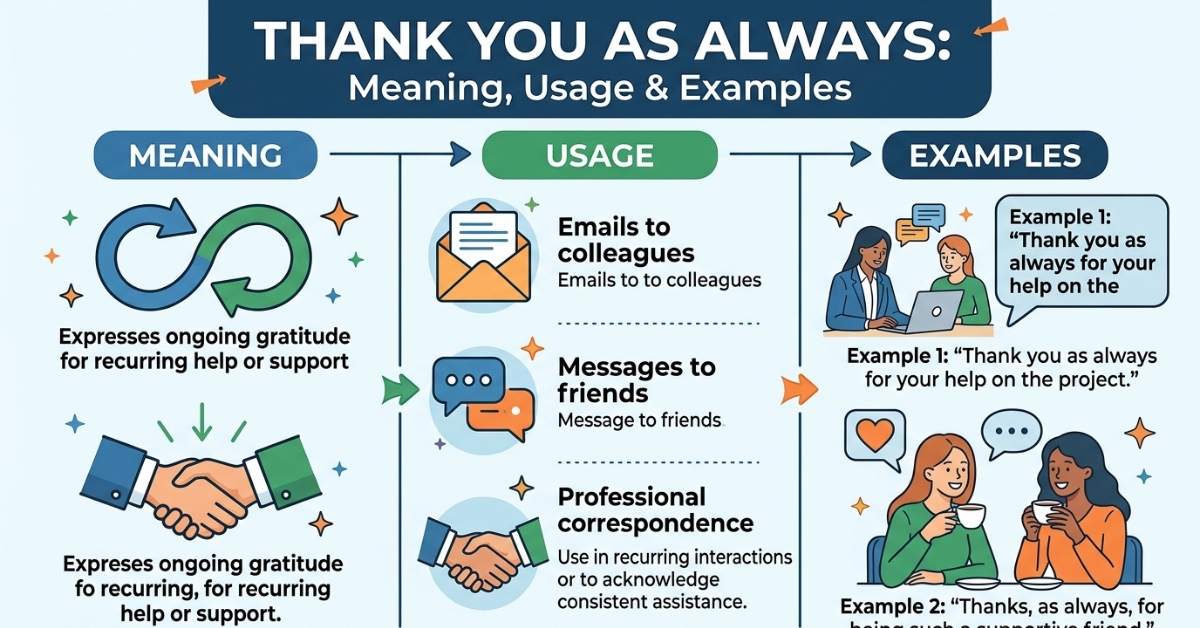
“Thank you as always” expresses gratitude for something a person has done while acknowledging that they have been helpful or supportive on a regular basis.
In simple terms, it can mean:
- Thank you for your continued help.
- Thank you for always being supportive.
- I appreciate your kindness, as usual.
- Thank you for being someone I can rely on.
- I appreciate your help once again.
For example:
“Thank you as always for your help with the project.”
Here, the speaker is thanking the person for their current assistance while also recognizing that this person has helped them before.
The phrase therefore carries two ideas: gratitude and consistency.
Is “Thank You as Always” Correct?
Yes, the expression is grammatically correct and natural in English.
It can be used in personal conversations, professional emails, thank-you notes, and messages. However, it works best when there is some history of support between the people involved.
For example:
“Thank you as always for taking the time to help.”
“Thank you as always for your thoughtful advice.”
“Thank you as always for your patience.”
If someone has helped you for the first time, a simpler expression such as “thank you for your help” may be more suitable.
“Thank You as Always” Grammar Explained
The expression “as always” is an idiomatic phrase meaning “as is usually the case” or “as has happened consistently before.”
When placed after “thank you,” it adds the idea that your gratitude is connected to someone’s usual behavior.
Compare these expressions:
| Expression | Meaning |
| Thank you | General gratitude |
| Thank you again | Gratitude expressed once more |
| Thank you as always | Appreciation for continued support |
| Thank you very much | Stronger emphasis on gratitude |
| I appreciate it | Thanks for a particular action |
The phrase can stand alone, but it is often followed by “for” and the reason for your appreciation.
“Thank you as always for your support.”
“Thank you as always for your guidance.”
“Thank you as always for being understanding.”
“Thank You Always” or “Thank You as Always”?
These expressions are similar, but they do not always sound the same.
“Thank you as always” is generally more natural when you are thanking someone for their regular help, kindness, or support.
For example:
“Thank you as always for your help.”
“Thank you always” is less common in everyday English. It can sometimes work when expressing lasting gratitude, especially in a sentence such as:
“I will thank you always for believing in me.”
Here, “always” suggests that the speaker will remain grateful indefinitely.
So, when you mean “thank you for your continued support,” the first construction is usually the better choice.
“As Always, Thank You” or “Thank You as Always”?
Both forms are grammatically acceptable.
Thank You as Always
This version sounds conversational and natural:
“Thank you as always for your support.”
It works particularly well in everyday communication and professional correspondence.
As Always, Thank You
This construction puts slightly more emphasis on the continuing nature of your appreciation:
“As always, thank you for your kindness.”
It can sound a little more polished or deliberate.
Neither is incorrect. Your choice can depend on the sentence and the tone you want to create.
How to Use the Phrase in a Sentence
One of the easiest ways to use this expression is to follow it with “for” and a noun or -ing phrase.
Here are some natural examples:
-
For help
“Thank you as always for your help with the presentation.”
-
For support
“Thank you as always for your support and encouragement.”
-
For guidance
“Thank you as always for your guidance throughout the project.”
-
For patience
“Thank you as always for your patience and understanding.”
-
For being there
“Thank you as always for being there when I need you.”
These examples work because they make the reason for the gratitude clear rather than relying on the expression alone.
Using the Phrase in an Email
A thank-you email can use this wording when you’re communicating with someone who regularly provides assistance or encouragement.
For example:
“Thank you as always for your prompt response. I really appreciate your help.”
It can be appropriate:
- After receiving regular assistance
- When following up with a colleague
- When thanking a mentor
- At the end of a professional request
- When acknowledging ongoing support
However, avoid adding it automatically to every message. If the recipient has helped you only once, “Thank you for your help” sounds more precise.
Using It in a Letter
A thank-you letter can use this expression to create a warm and appreciative tone.
For a friend:
“Thank you as always for listening and being there for me. I truly appreciate having someone I can count on.”
For a professional contact:
“Thank you as always for your guidance and continued support. Your feedback has been extremely valuable.”
Because the wording suggests an established relationship, it is particularly effective when the recipient has supported you repeatedly.
Is It Formal or Informal?
The expression can work in both formal and informal situations.
The surrounding language usually determines the tone.
Professional
“Thank you as always for your continued support and guidance.”
Casual
“Thank you as always! You’re the best.”
For business communication, adding a specific reason for your appreciation can make the sentence sound more sincere and professional.
What Does the Exclamation Mark Change?
“Thank you as always!” is perfectly acceptable when you want to sound enthusiastic or friendly.
Compare:
Thank you as always.
Calm, polite, and professional.
Thank you as always!
Warm, friendly, and enthusiastic.
For a formal business email, a period may be preferable. In a text message or personal note, an exclamation mark can make the message feel more expressive.
Thank You as Always in Tagalog
There is no single translation that works perfectly in every situation because the best wording depends on the context.
Some possible expressions include:
- Salamat gaya ng dati. — Thank you as usual.
- Salamat sa palagi mong pagtulong. — Thank you for always helping.
- Salamat sa palagi mong suporta. — Thank you for your continued support.
If you’re thanking someone specifically for their ongoing support, the third option can sound more natural than a literal translation.
Thank You as Always in Japanese
People searching for “thank you as always 意味” or “thank you as always の意味” are generally asking about the Japanese equivalent and its meaning.
A common casual expression is:
いつもありがとう (itsumo arigatou)
This can be understood as “thanks as always” or “thank you as always.”
For a more polite situation, you can use:
いつもありがとうございます (itsumo arigatou gozaimasu)
The latter is more appropriate when speaking respectfully to a colleague, customer, teacher, senior, or another person in a formal setting.
Thank You as Always Quotes
If you’re looking for short appreciation quotes, these variations can work well in cards, captions, or messages:
- “Thank you as always for being someone I can count on.”
- “Thank you for your kindness and continued support.”
- “I appreciate you being there whenever I need you.”
- “Thank you for always believing in me.”
- “Your support means more than you know. Thank you.”
Using slightly different wording can make a personal message feel more genuine rather than repetitive.
Similar Expressions and Their Meanings
Several expressions can communicate gratitude, but each has a slightly different purpose.
| Phrase | Meaning |
| Thank you | General appreciation |
| Thank you again | Thanks for something done another time |
| Thank you as always | Appreciation for consistent support |
| Thank you for everything | Broad or heartfelt gratitude |
| Thank you so much | Stronger emotional emphasis |
| I appreciate it | Appreciation for a particular action |
| Thanks, as usual | Casual thanks for something routinely done |
Choosing between them depends on the situation and your relationship with the recipient.
Common Mistakes to Avoid
Although the expression is correct, it can sound unnatural in certain situations.
Using It After a One-Time Favor
If someone has helped you for the first time, saying:
“Thank you as always for your help.”
could imply that they have helped you repeatedly.
A better option would be:
“Thank you for your help.”
Using It in Every Email
Repeating the same thank-you phrase in every email can make your writing sound automatic.
Instead, vary your wording:
- I really appreciate your help.
- Thanks again for your assistance.
- I appreciate your continued support.
- Many thanks for your guidance.
- Thank you for taking the time to help.
This keeps your communication natural while still expressing appreciation.
Confusing It With “Thank You Always”
These phrases can communicate slightly different ideas.
“Thank you as always” generally recognizes someone’s consistent behavior.
“I will thank you always” suggests that your gratitude will continue indefinitely.
The context determines which one sounds appropriate.
Frequently Asked Questions
What does “thank you as always” mean?
It expresses appreciation for someone’s current help while recognizing that they have consistently supported, helped, or encouraged you in the past.
Is “thank you as always” correct English?
Yes. It is grammatically correct and can be used in both personal and professional communication when the context involves ongoing support.
Can I say “thank you as always for your help”?
Yes. This is a natural construction when someone regularly assists you.
Is “as always, thank you” correct?
Yes. It is grammatically correct and communicates essentially the same idea. It may sound slightly more deliberate or polished.
Is “thank you always” or “thank you as always” better?
For everyday situations involving continued support, “thank you as always” is generally more idiomatic. “Thank you always” is less common but can work in contexts involving lasting gratitude.
Can I use this phrase in a professional email?
Yes. It is suitable when you have an established relationship with the recipient and they regularly provide assistance, guidance, or support.
What is the Japanese meaning?
いつもありがとう (itsumo arigatou) is a common casual equivalent, while いつもありがとうございます (itsumo arigatou gozaimasu) is the more polite form.
How do you say it in Tagalog?
Depending on the context, you can use “Salamat gaya ng dati” or “Salamat sa palagi mong suporta.” The latter specifically means thanks for your continued support.
Can the phrase be used in song lyrics?
Yes, the wording may appear in song titles or lyrics. However, if you’re searching for “thank you as always lyrics,” you need the specific song or artist to identify the correct work.
Final Thoughts
Thank you as always is a warm way to recognize someone’s continued kindness, help, or support. It is grammatically correct and works in emails, letters, conversations, and personal messages when there is an established pattern of appreciation.
The key is context. Use it when someone’s support is genuinely ongoing, and choose a simpler expression when you’re thanking someone for a one-time favor.
Most importantly, don’t feel that every thank-you message needs the same wording. A specific, sincere expression of appreciation will almost always sound more natural than a repeated phrase.
Leave a comment