

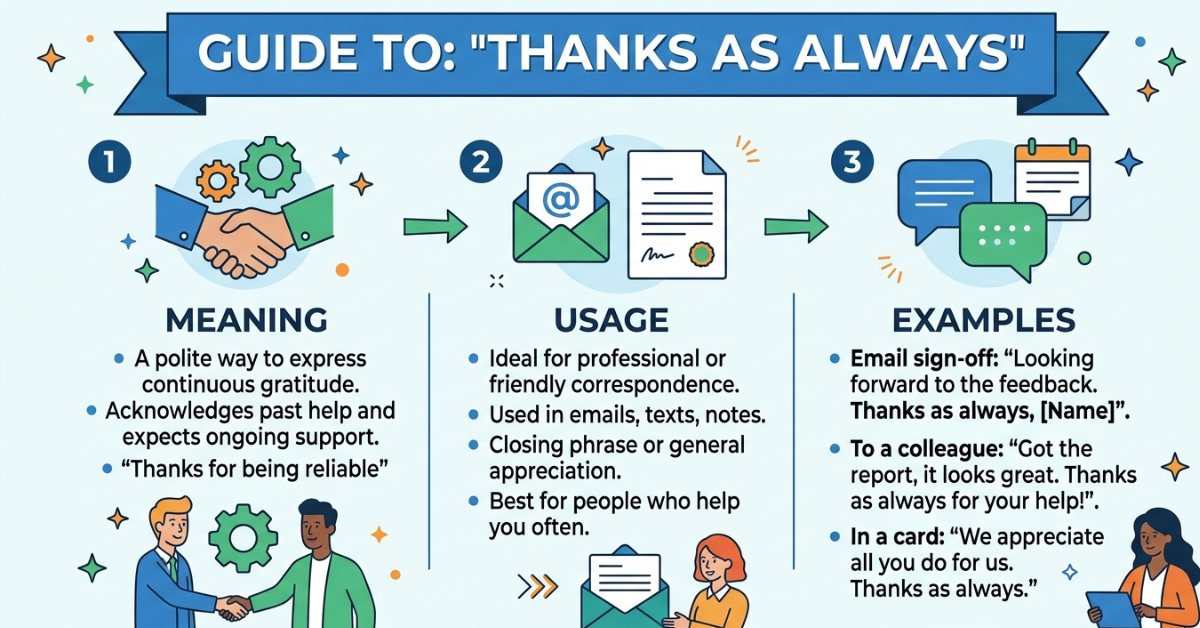
A simple “thanks” can show appreciation, but sometimes you want to recognize someone who is consistently helpful. That is where “thanks as always” comes in.
The phrase “thanks as always” means that you are grateful for someone’s help, support, kindness, or effort, just as you have been on previous occasions. It is warm, polite, and commonly used in everyday conversations, professional messages, and emails.
Whether you are wondering about the thanks as always meaning, its punctuation, or whether it sounds natural in an email, this guide explains everything you need to know.
Thanks as Always Meaning
The thanks as always meaning is essentially:
Thank you, as usual, for what you have done or continue to do for me.
The phrase recognizes ongoing or repeated support. It suggests that the person has helped you before and that you appreciate their continued kindness.
For example:
- Thanks as always for your help.
- Thanks as always for your support.
- Thanks as always for being there.
- Many thanks as always for your guidance.
The expression does not necessarily refer to one specific previous favor. It can simply acknowledge someone’s reliable support over time.
What Does “As Always” Add to “Thanks”?
There is a small but meaningful difference between “thanks” and “thanks as always.”
“Thanks” expresses appreciation for something specific.
“Thanks as always” expresses appreciation while also recognizing a person’s consistent behavior.
For example:
Thanks for helping me with the report.
This refers mainly to the current help.
Thanks as always for helping me with the report.
This suggests that the person regularly helps you and you appreciate that continued support.
Is “Thanks as Always” Correct?
Yes, “thanks as always” is grammatically acceptable and sounds natural in many situations.
It is particularly common in conversational English, emails, texts, and professional communication where the relationship is already established.
You can use it by itself:
Thanks as always!
Or you can make it more specific:
Thanks as always for your help.
Thanks as always for your support and guidance.
The second version often sounds more complete in professional writing because it tells the reader exactly what you appreciate.
Thanks as Always Comma: Do You Need One?
One common question is whether you need a comma in “thanks as always.”
In most cases, you do not need a comma between “thanks” and “as always.”
For example:
Thanks as always for your help.
This is perfectly natural.
You may also see:
Thanks, as always, for your help.
This punctuation is also possible. Here, “as always” is treated as an interrupting phrase, so commas set it apart from the rest of the sentence.
Which Version Is Better?
Both forms can be correct, but they have slightly different feels.
Without commas:
Thanks as always for your support.
This feels natural, direct, and conversational.
With commas:
Thanks, as always, for your support.
This gives slightly more emphasis to the phrase “as always” and can feel a little more polished.
For everyday emails and messages, “Thanks as always for your help” is perfectly fine.
Thanks as Always in an Email
The phrase works particularly well in emails when someone has provided repeated assistance, advice, feedback, or support.
For example, you might write:
Hi Sarah,
Thank you for reviewing the proposal. Your feedback was really helpful. Thanks as always for your support.
Best,
Emma
In a professional setting, “thanks as always” can create a warm tone without becoming overly formal.
Thanks as Always for Your Help
“Thanks as always for your help” is one of the most useful versions of the phrase.
You can use it after someone:
- Reviews your work
- Answers your questions
- Helps solve a problem
- Gives you advice
- Assists with a project
- Provides regular guidance
Example:
I really appreciate you taking the time to review these changes. Thanks as always for your help.
Thanks as Always for Your Support
“Thanks as always for your support” emphasizes ongoing encouragement or assistance.
It can work in both personal and professional contexts.
For example:
I appreciate everything you’ve done to help with this project. Thanks as always for your support.
Or:
Thanks as always for your support. It means a lot to me.
The second version is warmer and more personal.
Many Thanks as Always Meaning
The many thanks as always meaning is very similar to “thanks as always,” but “many thanks” sounds slightly more appreciative or polished.
“Many thanks” means a sincere or warm “thank you.”
Therefore:
Many thanks as always for your assistance.
essentially means:
Thank you very much, as always, for your continued assistance.
It is especially suitable for emails, letters, and professional correspondence.
Many Thanks as Always vs. Thanks as Always
Both expressions are correct, but the tone differs slightly.
| Phrase | Tone |
| Thanks as always | Friendly and conversational |
| Many thanks as always | Warm and slightly more formal |
| Thanks as always for your help | Friendly and specific |
| Many thanks as always for your support | Polished and appreciative |
If you’re writing to a colleague you communicate with regularly, “thanks as always” is usually enough.
If you’re writing a formal or semi-formal message, “many thanks as always” can sound more polished.
Thanks as Always Synonyms
If you want to avoid repeating the same expression, there are several thanks as always synonyms you can use.
Common Alternatives
- Thanks again for your help.
- As always, thank you for your support.
- I really appreciate your continued help.
- Thank you, as always, for your assistance.
- Many thanks for your continued support.
- I appreciate your help, as always.
- Thanks once again for your support.
- I’m grateful for your continued assistance.
- Thank you for always being so helpful.
- As always, I appreciate your help.
The best alternative depends on the relationship and the level of formality.
“As Always, Thank You” vs. “Thanks as Always”
These phrases have essentially the same meaning, but their sentence structure differs.
Thanks as always puts the expression of gratitude first:
Thanks as always for your advice.
As always, thank you puts “as always” at the beginning:
As always, thank you for your advice.
The second version can sound slightly more deliberate or formal.
When Should You Use “Thanks as Always”?
The phrase is most appropriate when someone has repeatedly helped, supported, advised, or encouraged you.
You might use it with:
- A colleague who regularly helps with your work.
- A manager or mentor who frequently gives you guidance.
- A friend who is consistently there for you.
- A client or professional contact who regularly provides support.
- A family member who continually helps you.
The key idea is continuity. If this is the person’s first time helping you, simply saying “thanks” or “thank you for your help” may sound more natural.
When “Thanks as Always” May Sound Awkward
Although the expression is correct, context matters.
If you have never interacted with someone before and they have just helped you once, saying:
Thanks as always!
could sound strange because there is no established pattern of support.
In that situation, use:
Thanks for your help!
or:
I really appreciate your assistance.
Save “as always” for situations where the person has a history of being helpful or supportive.
Thanks as Always Meaning in Different Contexts
The meaning remains broadly the same, but the tone can change depending on the situation.
In Professional Emails
It usually means:
I appreciate your continued assistance.
Example:
Thanks as always for your quick response.
In Friendly Conversations
It can mean:
I really appreciate you always being there for me.
Example:
You came through again. Thanks as always!
In Personal Messages
It can express warmth and familiarity:
Thanks as always for listening.
Here, the phrase highlights an ongoing relationship rather than simply thanking someone for one action.
Thanks as Always! With an Exclamation Mark
“Thanks as always!” is perfectly natural in casual communication.
The exclamation mark makes the message sound warmer and more enthusiastic.
Compare:
Thanks as always.
This feels calm and straightforward.
Thanks as always!
This feels friendlier and more enthusiastic.
For formal professional emails, a period may be more appropriate. For friendly emails, texts, or messages, an exclamation mark works well.
“Thanks as Always.” With a Period
“Thanks as always.” is also grammatically fine.
It simply has a more neutral tone.
If you want to sound particularly warm, you could add what you appreciate:
Thanks as always for your help.
This is often more natural than leaving the phrase on its own.
Thanks as Always 意味
If you’re searching for “thanks as always 意味,” the Japanese word 意味 (imi) means “meaning.”
So, “thanks as always 意味” refers to the meaning of “thanks as always.”
A natural Japanese explanation would be:
いつもありがとう (itsumo arigatou) — “Thank you as always” or “Thanks as always.”
Depending on the context and level of politeness, Japanese has several ways to express ongoing gratitude. However, いつもありがとう is a common casual expression for thanking someone for their continued kindness or help.
Thanks as Always Definition
A simple thanks as always definition is:
“Thanks as always” is an expression of gratitude used to thank someone for their continued or repeated help, support, kindness, or consideration.
It combines:
- Thanks — an expression of gratitude
- As always — indicating that something happens regularly or continues to be true
Together, the phrase acknowledges both the current reason for saying thank you and the person’s consistent behavior.
Examples of “Thanks as Always”
Here are some natural examples you can use in everyday situations:
- Thanks as always for your help.
- Thanks as always for your support.
- Thanks as always for the quick response.
- Thanks as always for your advice.
- Thanks as always for being there.
- Thanks as always for taking the time to help.
- Thanks as always for your guidance.
- Thanks as always for checking in.
- Many thanks as always for your assistance.
- Thanks as always! I really appreciate it.
Frequently Asked Questions
Is “thanks as always” grammatically correct?
Yes. “Thanks as always” is a natural and grammatically acceptable expression of gratitude. It is commonly used in conversations, messages, and emails.
What does “thanks as always” mean?
It means thank you for your help, support, or kindness, as you have consistently provided it before. It recognizes someone’s ongoing or repeated support.
Is there a comma in “thanks as always”?
A comma is not required in “thanks as always for your help.” You can also write “Thanks, as always, for your help” when treating “as always” as an interrupting phrase.
What is another way to say “thanks as always”?
Possible thanks as always synonyms include “thanks again,” “many thanks,” “I appreciate your continued help,” and “as always, thank you.”
Is “many thanks as always” correct?
Yes. “Many thanks as always” is correct and sounds warm and slightly more formal than “thanks as always.”
Can I use “thanks as always” in a professional email?
Yes. It works well in professional emails, especially when you’re thanking someone for their repeated assistance, guidance, or support.
Final Thoughts on “Thanks as Always”
The phrase “thanks as always” is a simple way to express more than ordinary gratitude. It tells someone that you appreciate not only what they have done now but also the fact that they have consistently been helpful or supportive.
Use “thanks as always for your help” when you want a friendly, natural tone, or choose “many thanks as always” when you want something slightly more polished. And when punctuation matters, remember that “Thanks as always for your support” works perfectly well without a comma.
Ultimately, the best expression depends on your relationship with the reader and the tone you want to create. When used in the right context, “thanks as always” is warm, genuine, and perfectly natural.
Leave a comment