

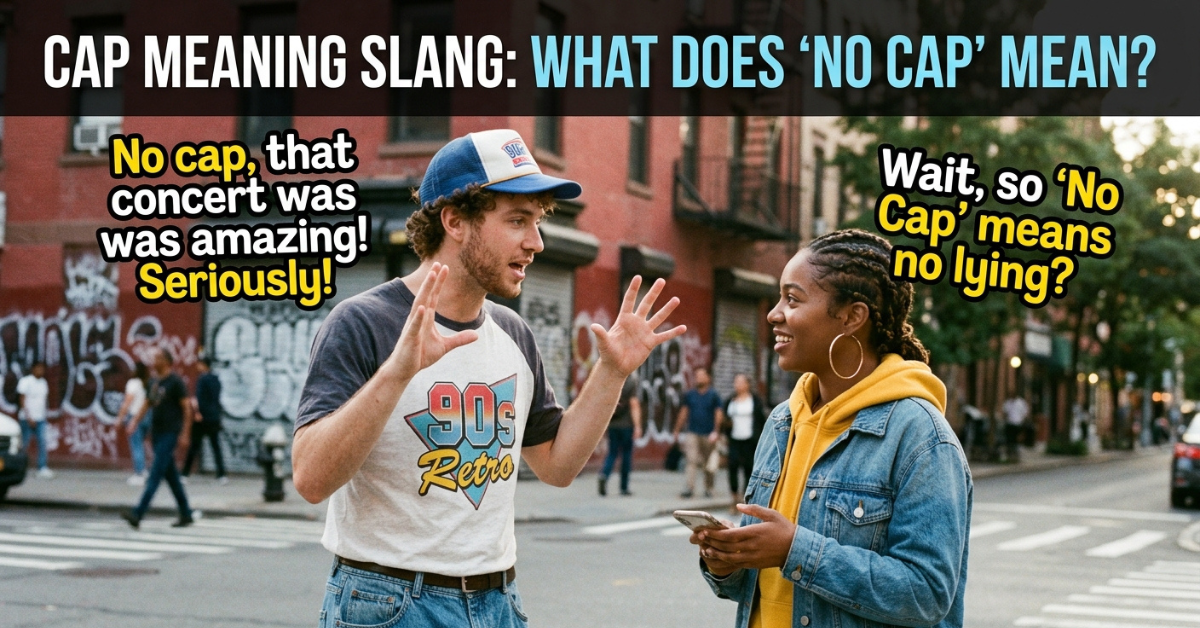
Have you ever seen someone reply “That’s cap” or end a sentence with “no cap” and wondered what they meant? If so, you’re definitely not alone. The cap meaning slang has become common in texts, TikTok comments, memes, music, and everyday online conversations.
In modern slang, cap usually means a lie, exaggeration, or untrue claim, while no cap means “for real,” “seriously,” or “I’m telling the truth.” Cambridge Dictionary now recognizes no cap as slang that emphasizes the truth of a statement.
However, the word has a longer history than many people realize. Its slang use goes back well before TikTok and Gen Z, with strong connections to African American English, boasting, exaggeration, and competitive verbal traditions.
What Does Cap Mean in Slang?
The simplest cap meaning slang definition is a lie, false statement, or exaggeration.
When someone says “You’re capping,” they mean that you are probably lying, exaggerating, or making a claim that sounds difficult to believe.
For example:
“I ran 20 miles before breakfast.”
Someone might respond:
“Bro, that’s cap.”
In this situation, the person means, “I don’t believe you” or “That sounds like a lie.”
Merriam-Webster also recognizes cap as an African American English slang verb that means making an untrue statement with the intent to deceive.
Quick Definition
| Slang | Meaning |
| cap | A lie, exaggeration, or false claim |
| capping | Lying or exaggerating |
| you’re capping | You’re lying or exaggerating |
| that’s cap | That isn’t true |
| no cap | For real; seriously; honestly |
| stop the cap | Stop lying or exaggerating |
What Does No Cap Mean in Slang?
No cap means “no lie,” “for real,” “seriously,” or “I’m telling the truth.”
The phrase works as the opposite of cap. For instance, if someone says:
“This is the best burger I’ve ever had, no cap.”
They want to make it clear that they genuinely mean what they said.
Cambridge Dictionary defines no cap as slang that emphasizes the truth of a statement. Merriam-Webster also describes the expression as an informal way to say “for real” or “seriously.”
No Cap Meaning Slang Definition in Simple Words
If you want the no cap meaning slang definition in one simple line:
No cap = I’m not lying or exaggerating.
People can place the expression at either end of a sentence:
- “No cap, that movie was amazing.”
- “That movie was amazing, no cap.”
Both sentences communicate essentially the same idea.
What Does “That’s Cap” Mean?
“That’s cap” means “That’s a lie,” “That’s not true,” or “You’re exaggerating.”
People commonly use the expression when someone makes a claim that sounds unbelievable.
For example:
Person A: “I finished the whole assignment in ten minutes.”
Person B: “That’s cap.”
Here, that’s cap provides a casual way to express disbelief.
The tone can vary from playful teasing to a genuine accusation. Among friends, it may simply mean, “Come on, you’re exaggerating.”
What Does “Stop the Cap” Mean?
“Stop the cap” means “stop lying,” “stop exaggerating,” or “stop making things up.”
The phrase builds directly on the slang meaning of cap.
For example:
“You said you never use social media, but I saw your account yesterday. Stop the cap.”
You’ll often see the expression in online conversations, memes, gaming communities, and social media comments.
People also use “stop capping” in a similar way.
What Is Cap Meaning Slang on Social Media?
On social media, cap often works as a quick response to a questionable statement.
You might see comments such as:
- “Cap.”
- “That’s cap.”
- “Bro is capping.”
- “Stop the cap.”
- “No cap.”
- “He’s capping hard.”
The baseball-cap emoji can also act as a visual shorthand for cap. Users may add it when they want to suggest that a statement sounds false or exaggerated.
Why Is Cap So Common Online?
Short slang expressions work particularly well on social media because they communicate a reaction almost instantly.
Instead of writing:
“I don’t believe what you’re saying because I think you’re exaggerating.”
Someone can simply write:
“Cap.”
That single word delivers the same general reaction in a much faster and more casual way.
Cap Meaning Slang Origin
The cap meaning slang origin is older than many people realize. The expression did not begin with TikTok, Instagram, or Gen Z.
Modern cap has strong associations with African American English, while historical evidence shows related uses going back decades.
Merriam-Webster notes that capping has appeared in African American English for decades and possibly longer.
Dictionary.com explains that cap in Black slang developed meanings connected with bragging, exaggerating, or lying, with evidence reaching back to the early 1900s. The term also connects with the competitive verbal tradition known as the dozens, where participants exchange increasingly elaborate insults or put-downs.
Did Cap Come From Hip-Hop?
Hip-hop played an important role in bringing the expression to a much wider audience.
Merriam-Webster traces the popularity of no cap to African American English and notes its use in Atlanta hip-hop during the early 2010s. Music from Atlanta artists helped carry the phrase into mainstream popular culture and internet language during the late 2010s and early 2020s.
Social media later made cap even more visible, but the slang itself existed long before today’s internet culture.
No Cap Meaning Slang Origin
The no cap meaning slang origin connects directly to the older meaning of cap as boasting, exaggerating, or lying.
The basic logic looks like this:
- Cap = a lie, boast, or exaggeration.
- No cap = no lie or exaggeration.
- Therefore, no cap = “I’m being completely serious.”
Merriam-Webster connects the expression with African American English and Atlanta hip-hop, particularly during the 2000s and 2010s.
Dictionary.com also notes that no cap appeared on Twitter by at least 2012, although people likely used it in spoken language before that.
Cap Meaning Slang Urban Dictionary
Many people search for the cap meaning slang Urban Dictionary because Urban Dictionary has long served as a popular source for internet slang.
However, the site relies on user-generated definitions. As a result, entries can include jokes, regional interpretations, multiple meanings, or explanations that do not represent widespread usage.
Established dictionaries provide stronger references when you want to understand the standard meaning. Cambridge identifies no cap as slang that emphasizes the truth of a statement, while Merriam-Webster documents cap and capping in African American English as terms connected with lying or making an untrue statement.
Urban Dictionary can still show how people use slang casually, but readers should not automatically treat every entry as an authoritative definition or historical explanation.
What Does “Big Cap” Mean?
“Big cap” generally means a big lie, major exaggeration, or especially unbelievable claim.
For example:
“He said he bought a private jet yesterday. That’s big cap.”
Unlike no cap, the phrase does not have the same fixed or widely established status. Still, its meaning becomes clear when you understand the standard slang sense of cap.
Someone might also say “that’s a big cap” to emphasize just how unbelievable a statement sounds.
What Does “All Cap” Mean?
This expression needs some context because “all cap” can have different interpretations.
In internet slang, someone may use all cap informally to suggest that everything a person says consists of lies or exaggerations.
However, “all caps” has a completely different meaning in writing. It refers to text written entirely in capital letters, such as:
THIS IS WRITTEN IN ALL CAPS.
Cambridge Dictionary explains that caps can refer to capital letters. Online, people often associate all-capital writing with shouting or strong emphasis.
So:
- all cap → may informally suggest lots of lying or exaggeration
- all caps → text written in capital letters
The two expressions should not automatically be treated as interchangeable.
What Does “You’re Capping” Mean?
“You’re capping” means “you’re lying” or “you’re exaggerating.”
It functions as the verb form of the slang.
For example:
“You said you met three celebrities at the airport. You’re capping.”
The expression does not always suggest serious deception. Friends may use it simply to point out that someone has made an exaggerated or ridiculous claim.
What Does “No Cap” Mean in a Text?
In texting, no cap usually means:
- “Seriously.”
- “Honestly.”
- “For real.”
- “I’m not lying.”
- “I genuinely mean this.”
For example:
“No cap, you did a great job.”
The speaker uses no cap to emphasize that they genuinely believe the person did a great job.
Slang remains highly informal and can change quickly, so the exact tone depends on the people involved and the surrounding conversation. Cambridge also notes that slang can change rapidly and often relates to particular social groups.
What Does “Cap” Mean in Drug Slang?
There is an important distinction here.
Cap can have a drug-related dictionary meaning that has nothing to do with the modern slang meaning of “lie.”
Merriam-Webster lists cap as a noun that can refer to a small amount of an illegal or regulated drug, particularly one contained in a capsule. Collins also lists cap as slang for a capsule, especially one containing a narcotic drug, and identifies this sense as a shortening of capsule.
Therefore:
- “That’s cap” → usually means “That’s a lie.”
- “A cap” in a drug-related context → can refer to a capsule or small amount of a drug.
The surrounding context determines which meaning applies.
Flat Cap Meaning
A flat cap is not internet slang.
The term refers to a soft, traditionally British hat with a relatively flat crown and a short peak at the front. Cambridge and Oxford dictionaries define flat cap as a type of headwear and note its traditional association with working-class or working men’s clothing.
So if someone says:
“He was wearing a flat cap.”
They are talking about clothing, not lying.
Red Cap Meaning
Red cap can also have several meanings depending on the context.
Historically, Red Cap served as a term for a military policeman, particularly in British military slang. An Australian National University glossary of World War I slang records Red Cap as a military policeman and connects the name with the distinctive headwear associated with the role.
This example shows why you should always consider the surrounding words before interpreting cap as modern internet slang.
“Peel Your Cap” Meaning
“Peel your cap” is not a standard modern slang expression with one widely recognized definition comparable to “no cap” or “that’s cap.”
Its meaning may depend on the specific community, song, joke, or sentence where you encounter it. For that reason, you should not automatically interpret it as another version of no cap.
Searches for cap often bring together unrelated expressions, so context plays an important role.
“Colonies Cap” Meaning
“Colonies cap” is not a commonly established slang expression meaning “lie” or “no lie.”
If you encountered colonies cap in a post, game, song, historical text, or conversation, the surrounding sentence would help determine what the writer meant.
Without that context, assigning it the standard cap = lie definition would be misleading.
Cap vs. No Cap: What’s the Difference?
The easiest way to remember the difference is to treat the two expressions as opposites.
| Expression | Meaning |
| Cap | Lie or exaggeration |
| That’s cap | That’s not true |
| You’re capping | You’re lying or exaggerating |
| Stop the cap | Stop lying or exaggerating |
| No cap | For real; honestly |
| No cap, seriously | I genuinely mean it |
| Big cap | A big lie or exaggeration |
Simple Example
Person A: “I can run faster than every professional athlete.”
Person B: “That’s cap.”
Person A: “No cap! I’m serious.”
Here, cap signals disbelief, while no cap emphasizes that the speaker claims to be telling the truth.
How to Use Cap Slang Correctly
If you want to use the expression naturally, a few simple guidelines can help.
1. Use It in Informal Situations
Cap is casual slang. It works well in:
- Text messages
- Social media comments
- Memes
- Casual conversations
- Gaming chats
- Informal online discussions
Formal business writing and academic assignments usually require more standard language.
2. Use “No Cap” to Emphasize Sincerity
You can place no cap before or after a statement:
“No cap, this is the best restaurant I’ve tried.”
You can also put it at the end:
“This is the best restaurant I’ve tried, no cap.”
Both versions emphasize that you genuinely mean what you said.
3. Use “That’s Cap” to Challenge a Claim
When someone makes a claim that you strongly doubt, you can respond:
“That’s cap.”
A shorter response also works:
“Cap.”
The one-word version can sound more blunt or playful depending on the situation.
Why Does Cap Mean Lie?
Linguists have not established one completely certain path for the modern slang meaning, but historical evidence provides several useful clues.
Merriam-Webster points to older meanings of cap involving boasting, insulting, and lying. Green’s Dictionary of Slang also records related meanings such as bragging, exaggerating, lying, insulting, surpassing, or outdoing someone across historical examples.
Merriam-Webster discusses connections between the expression and African American verbal traditions such as the dozens and signifying.
The modern slang meaning therefore did not suddenly appear on social media. It developed through a much longer history of informal language and Black linguistic culture before hip-hop and internet culture helped spread it to wider audiences.
Is Cap Still Slang in 2026?
Yes. Cap and no cap remain recognizable informal slang in 2026, particularly on social media and in casual digital communication.
Still, slang changes constantly. Some expressions become mainstream, others fade away, and some develop new meanings over time.
Cambridge Dictionary notes that slang can change quickly and may eventually disappear from common use.
For that reason, the definitions in this article describe current usage rather than a permanent meaning that can never change.
Frequently Asked Questions About Cap Meaning Slang
What does cap mean in slang?
Cap means a lie, false claim, boast, or exaggeration. When someone says “that’s cap,” they usually mean that something sounds untrue or exaggerated.
What does no cap mean in slang?
No cap means “for real,” “seriously,” or “I’m telling the truth.” People use it to emphasize that they are being sincere.
What does “that’s cap” mean?
“That’s cap” means “that’s not true” or “you’re lying.” Depending on the situation, someone might use it seriously or as playful teasing.
What does “stop the cap” mean?
“Stop the cap” means “stop lying,” “stop exaggerating,” or “stop making things up.”
What is the cap meaning slang origin?
The modern slang sense has strong connections to African American English. Historical evidence links related uses with boasting, lying, insulting, and verbal competition. Hip-hop later helped spread the expression to a much wider audience.
What does no cap mean according to Cambridge Dictionary?
Cambridge Dictionary defines no cap as slang that emphasizes the truth of what someone says.
What does no cap mean according to Merriam-Webster?
Merriam-Webster defines no cap as an informal expression meaning “for real” or “seriously.”
Does cap mean a drug?
It can. In a separate dictionary sense, cap can refer to a small amount of a drug, particularly one contained in a capsule. This meaning differs from the modern slang use of cap for a lie.
Does cap mean hat?
Yes. In ordinary English, cap can refer to a type of head covering. The word also has meanings related to limits, capital letters, covers, and other subjects.
Conclusion
The easiest way to remember the cap meaning slang is simple: cap means a lie, exaggeration, or false claim, while no cap means for real or honestly. Expressions such as “that’s cap,” “you’re capping,” and “stop the cap” all build on the same basic idea.
The slang has a deeper history than today’s social media culture. Its modern use connects strongly with African American English and later spread through hip-hop before becoming common across internet culture.
Keep in mind that cap has several unrelated meanings as well. It can refer to a hat, a limit, capital letters, or even a capsule in a drug-related context.
Whenever you see the word, check the surrounding sentence before deciding what it means. If someone makes a claim that sounds completely unbelievable, though, you already know the perfect response: “That’s cap.”
Leave a comment