

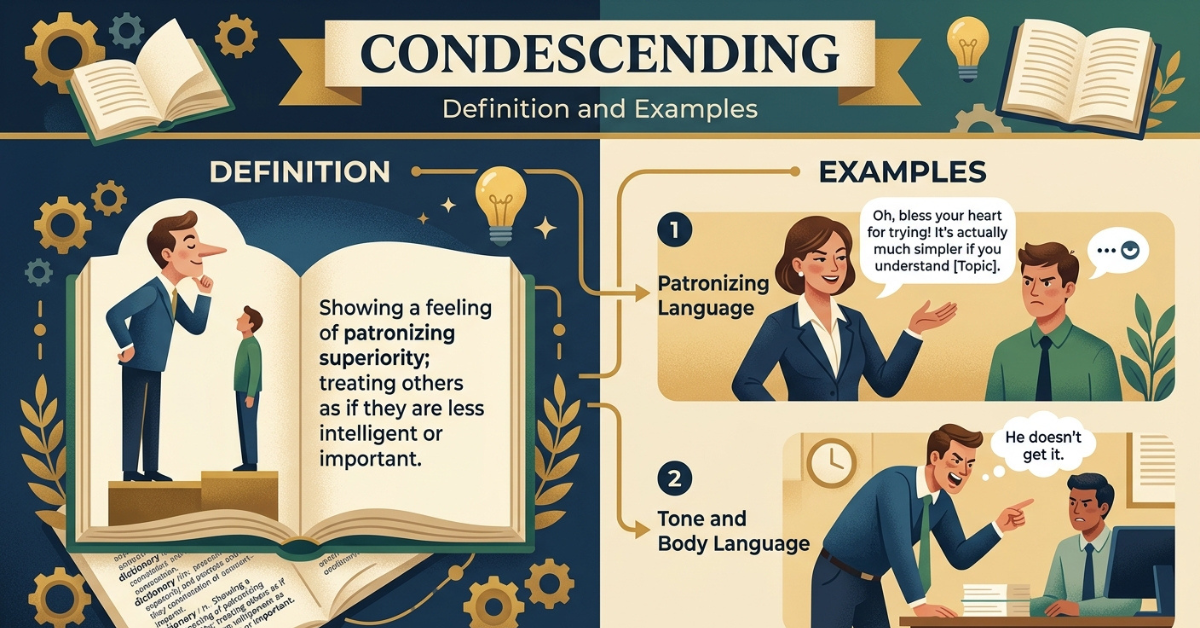
Have you ever talked to someone who made you feel like you were somehow less intelligent than them? Maybe they explained something obvious in an exaggeratedly simple way or spoke to you with an overly superior tone. That kind of attitude is often described as condescending.
The condescending meaning refers to behaving as though you are more intelligent, capable, or important than another person. It is usually communicated through someone’s tone, words, facial expressions, or attitude rather than through the literal meaning of what they say.
In this guide, we’ll explain the condescending meaning in English, look at everyday examples, compare condescending with patronizing, and explain phrases such as “you are so condescending” in simple terms.
What Is the Condescending Meaning?
The condescending meaning is essentially an attitude of superiority toward another person. Someone who is condescending may speak to others as if they are ignorant, inexperienced, or incapable of understanding something.
The important point is that condescension is often about attitude and tone. A sentence can sound polite on the surface but still feel condescending because of the way it is delivered.
For example:
“Oh, don’t worry. I’ll explain it to you since you probably haven’t dealt with this before.”
The speaker may claim to be helping, but the wording suggests that the other person is less capable. That’s what makes the statement condescending.
Condescending Meaning Definition
A simple condescending meaning definition is:
Condescending: behaving toward someone as though you are superior to them, especially by treating them as less intelligent, experienced, or capable.
Common signs of a condescending attitude include:
- Talking down to someone
- Overexplaining something they already understand
- Using an exaggeratedly patient tone
- Making someone feel intellectually inferior
- Giving unwanted explanations in a superior manner
- Using sarcasm to highlight another person’s supposed lack of knowledge
Being helpful is not automatically condescending. The difference usually comes down to respect and attitude.
Condescending Meaning Simple
If you need the condescending meaning simple, think of it as:
“Talking to someone as if you are better or smarter than them.”
For kids, you could explain it even more simply:
“When someone talks to you like you are not smart enough to understand.”
Condescending Meaning for Kids
Imagine a child already knows how to tie their shoes. An older child says:
“Wow, you finally learned how to tie your shoes! Good job!”
Depending on the situation and tone, this could be condescending because the speaker is treating a normal accomplishment as though it is surprisingly impressive for that person.
Another example is when someone says:
“Let me show you how to do this. It’s really easy.”
If the person has already said they know how to do it, that comment may come across as talking down to them.
What Does Being Condescending Mean?
Being condescending meaning refers to acting superior toward another person.
Someone can be condescending without openly insulting anyone. Their behavior might sound polite but still communicate, “I know better than you.”
For instance:
“That’s a cute idea, but you’ll understand why it won’t work once you have more experience.”
This statement dismisses the other person’s idea while implying that they lack the knowledge to understand the situation.
To Be Condescending Meaning
The to be condescending meaning is to communicate with someone from a position of assumed superiority.
A person may be condescending because they believe they are more knowledgeable, experienced, mature, or capable. However, the behavior can also happen unintentionally.
Condescending Meaning and Examples
Looking at real situations makes the definition easier to understand.
Example 1: At Work
“Don’t worry about that report. I’ll handle it. These things can be a little complicated.”
If the colleague has already demonstrated that they can handle reports, this may sound dismissive and superior.
Example 2: During a Conversation
“You actually know about that? I’m surprised.”
The speaker may intend to express surprise, but the comment can imply that the other person was not expected to be knowledgeable.
Example 3: In an Argument
“You’ll understand when you’re older.”
This phrase can be condescending because it dismisses someone’s opinion based on their age rather than addressing their argument.
Example 4: Giving Advice
“Let me explain how this works.”
There is nothing inherently rude about explaining something. However, if the listener has already shown that they understand it, the phrase may sound patronizing or condescending.
Condescending Meaning Example in Everyday Speech
Consider this exchange:
Person A: “I’ve already read the instructions.”
Person B: “Okay, but I’ll explain them anyway because they can be confusing.”
Person B might genuinely want to help. However, if their tone suggests that Person A cannot understand basic instructions, the response can feel condescending.
This is why sounding condescending meaning is closely connected to tone and context. The same words can be helpful in one situation and insulting in another.
“You Are So Condescending” Meaning
When someone says “you are so condescending,” they are usually accusing another person of talking down to them.
They may feel that the other person:
- Is treating them as unintelligent
- Is acting superior
- Is dismissing their opinions
- Is explaining obvious things unnecessarily
- Is using a patronizing tone
For example:
“I know how to use the software. You don’t need to explain every button.”
If the other person continues explaining while acting as though the speaker knows nothing, they might be told, “You are so condescending.”
The phrase is generally criticism, not a compliment.
Sounds Condescending Meaning
“Sounds condescending” means that something gives the impression of superiority, even if that was not necessarily the speaker’s intention.
For example:
“It’s really not that difficult.”
This could be encouraging in one context, but condescending in another. If someone is struggling with a difficult task, saying “It’s really not that difficult” may make them feel inadequate rather than supported.
The listener’s interpretation matters because condescension often comes from how something is communicated, not just the dictionary definition of individual words.
Rude and Condescending Meaning
Although rude and condescending are related, they are not exactly the same.
Rude behavior is generally disrespectful, impolite, or offensive. Condescending behavior specifically suggests superiority.
For example:
- “Shut up.” — Rude
- “You clearly don’t understand this, so I’ll explain it slowly.” — Condescending
- “You’re an idiot.” — Rude and potentially condescending
- “That’s adorable. You really think you understand how this works.” — Rude and condescending
A person can therefore be condescending without using an obvious insult.
Patronizing vs Condescending Meaning
The difference between patronizing vs condescending meaning can be subtle because the two words are frequently used as synonyms.
Both describe behavior that can make someone feel inferior. However, patronizing often emphasizes treating someone with an exaggerated or insincere kindness, while condescending more broadly emphasizes an attitude of superiority.
For example:
“Aww, don’t worry about it. These things are too complicated for you.”
This can be both patronizing and condescending.
A useful way to remember the distinction is:
| Term | General idea |
| Condescending | Acting as though you are superior to someone |
| Patronizing | Treating someone as though they are less capable, often with fake or excessive kindness |
| Rude | Behaving in an impolite or disrespectful way |
There is considerable overlap, so in everyday English, people may use patronizing and condescending interchangeably.
Very Condescending Meaning
Very condescending describes behavior that strongly communicates superiority.
For example:
“Oh, you finally figured it out. I was beginning to think you’d never get there.”
The phrase is not merely dismissive. It openly suggests that the other person is less capable.
Someone might describe such behavior as very condescending because the superiority is especially obvious.
Non-Condescending Meaning
The non condescending meaning refers to communication that is respectful, straightforward, and considerate rather than superior.
Compare these two approaches:
Condescending:
“Let me explain this because you obviously don’t understand it.”
Non-condescending:
“Would you like me to walk through it with you?”
The second version gives the other person a choice and does not assume they are incapable.
How to Avoid Sounding Condescending
If you want to communicate without sounding superior, try these approaches:
- Ask before explaining.
Instead of assuming someone needs help, ask whether they want it. - Avoid unnecessary simplification.
Don’t automatically explain basic concepts unless the person asks. - Listen first.
Make sure you understand what someone knows before responding. - Use neutral language.
Avoid phrases that imply someone is unintelligent or inexperienced. - Respect different opinions.
Disagreement does not mean the other person is incapable of understanding.
Self-Condescending Meaning
Self condescending meaning is not a common standard English expression. People sometimes use it when they mean that someone is putting themselves down or treating themselves as inferior.
However, condescending normally describes an attitude toward another person, not self-criticism.
If you mean being overly critical of yourself, terms such as self-deprecating, self-critical, or self-disparaging may be more accurate.
For example:
“I’m terrible at everything. I can’t do anything right.”
That is better described as self-critical or self-deprecating rather than condescending.
Condescending Meaning in Farsi
For the condescending meaning in Farsi, the closest translations depend on the context.
Common ways to convey the idea include:
- تحقیرآمیز — humiliating or demeaning
- از بالا به پایین صحبت کردن — speaking down to someone
- متکبرانه — arrogantly
- با لحنی تحقیرآمیز — in a demeaning tone
For example, “He spoke to me in a condescending way” can be expressed as:
او با لحنی تحقیرآمیز با من صحبت کرد.
The exact translation can change depending on whether the emphasis is on arrogance, disrespect, or talking down to someone.
“I Associate Support With Condescending” Meaning
The phrase “I associate support with condescending” is not a standard English expression, but its intended meaning can usually be understood from context.
It may mean that someone has come to connect being offered help or support with feeling talked down to. In other words, previous experiences may have made support feel patronizing rather than respectful.
A clearer way to express the idea would be:
“I associate being supported with being talked down to.”
Or:
“I tend to associate support with condescending behavior.”
This distinction matters because support itself is not condescending. It becomes condescending when the way it is offered implies that the person receiving help is inferior or incapable.
Why Do People Sound Condescending?
Condescension can come from several different behaviors or attitudes. Sometimes it is intentional; other times, the speaker may not realize how they sound.
Common reasons include:
- Feeling superior: Someone genuinely believes they know more.
- Poor communication habits: They may routinely overexplain.
- Lack of awareness: They don’t realize their tone is dismissive.
- Frustration: Irritation can make otherwise neutral words sound insulting.
- Assumptions: They assume another person lacks knowledge without checking.
- Social or workplace hierarchy: Someone may use their position to establish superiority.
Intent and impact can also be different. A person may intend to help but still make someone feel belittled.
Condescending vs Helpful: What’s the Difference?
The easiest way to tell the difference is to consider respect and choice.
Helpful communication says:
“Would you like some help with that?”
Condescending communication may say:
“Clearly you need help with that.”
Helpful communication recognizes another person’s ability to make decisions. Condescending communication assumes the speaker knows better and may undermine the other person’s confidence.
Synonyms for Condescending
Depending on the context, possible synonyms include:
- Patronizing
- Superior
- Dismissive
- Arrogant
- Haughty
- Snobbish
- Belittling
- Disparaging
- Pompous
- Talking down to someone
These words are not perfect substitutes in every sentence, so context matters.
FAQs About the Condescending Meaning
What is the condescending meaning in simple words?
Condescending means talking to someone as if you are better, smarter, or more capable than they are.
Is condescending a negative word?
Yes. Condescending generally has a negative meaning because it describes behavior that can make another person feel inferior or disrespected.
What is an example of being condescending?
Saying, “Don’t worry, I’ll explain it slowly so you can understand” to someone who already understands the subject can be condescending.
What does “you are so condescending” mean?
It means the speaker believes you are talking down to them or treating them as though they are less intelligent or capable.
Is patronizing the same as condescending?
They are very similar and often overlap. Condescending focuses on an attitude of superiority, while patronizing can emphasize treating someone as inferior through exaggerated or insincere kindness.
What does non-condescending mean?
Non-condescending means communicating without treating someone as inferior. It usually involves respectful, direct, and considerate communication.
Can someone be condescending without meaning to?
Yes. A person may intend to be helpful but use language, assumptions, or a tone that makes the other person feel talked down to.
Conclusion
The condescending meaning is simple once you focus on the attitude behind the words: it means treating or speaking to someone as though you are superior to them. It can appear through an overly simplistic explanation, dismissive comment, sarcastic remark, or patronizing tone.
Remember that condescending, patronizing, and rude are related but not identical. Most importantly, communication can be helpful without being condescending when it respects the other person’s knowledge, choices, and abilities.
If you’re exploring English vocabulary, comparing related words such as patronizing, dismissive, arrogant, and belittling can make their differences much easier to recognize in everyday conversations.
Leave a comment