

A single laughing emoji can say a lot without typing a single word. It can show genuine amusement, make a joke feel lighter, or even soften an awkward message. But here is the interesting part: laughing emoji meaning can change depending on the specific emoji, the conversation, and even who sent it.
The crying laughing emoji may suggest that something is extremely funny, while a sweating laughing emoji can mean nervous laughter or relief. Meanwhile, newer and more playful versions, such as cat and SpongeBob-related laughing emojis, often carry their own internet-culture flavor.
So, what does each one actually mean? Let’s break down the different laughing emoji meaning and when people typically use them.
What Is the Laughing Emoji Meaning?
The laughing emoji generally communicates amusement, humor, or a strong reaction to something funny. It is commonly used in texts, social media comments, messaging apps, and online conversations.
However, there is no single meaning that applies in every situation. Context matters.
A laughing emoji might mean:
- “That is really funny.”
- “I am laughing at what you said.”
- “You have to be joking.”
- “I cannot believe this happened.”
- “I am reacting playfully.”
- “I am trying to make this conversation less serious.”
The relationship between the people also matters. A friend may use a laughing emoji to genuinely show amusement, while someone you barely know might use one simply to keep the conversation friendly.
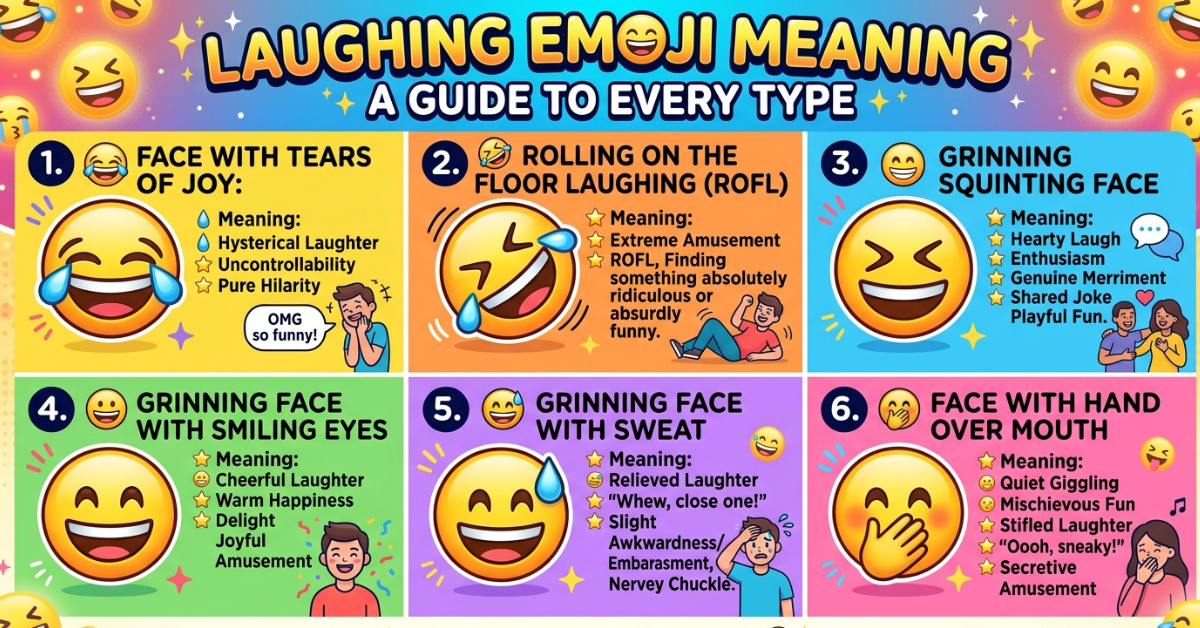
Crying Laughing Emoji Meaning
The crying laughing emoji meaning is usually straightforward: something is so funny that the person is figuratively crying with laughter.
It is one of the most recognizable ways to express strong amusement online. People often use it after jokes, funny stories, unexpected comments, memes, or embarrassing situations that become funny afterward.
For example:
“I accidentally sent the message to the wrong group.”
A response using the crying laughing emoji can communicate, “That is hilarious.”
It does not necessarily mean the sender is literally crying. Instead, the tears represent an exaggerated reaction to something funny.
When to Use the Crying Laughing Emoji
It works particularly well when:
- Something genuinely makes you laugh.
- You want to emphasize that a joke was very funny.
- A friend tells you an embarrassing but harmless story.
- You are reacting to a funny meme or video.
Rolling on the Floor Laughing Emoji Meaning
The rolling on the floor laughing emoji meaning represents an even stronger reaction. It suggests that something is ridiculously funny or that the person is laughing uncontrollably.
The phrase “rolling on the floor laughing” is itself an exaggerated expression. Online, it is often shortened to the acronym ROFL.
The rolling on floor laughing emoji meaning is therefore close to:
- “I am laughing so hard.”
- “This is absolutely hilarious.”
- “I cannot stop laughing.”
- “That was unexpectedly funny.”
People often use it when the ordinary laughing reaction does not seem strong enough.
Rolling on the Floor Laughing vs. Crying Laughing
These two are easy to confuse because both communicate intense amusement.
The crying laughing emoji tends to mean “This is extremely funny.”
The rolling-on-the-floor-laughing emoji often feels more like “This is so ridiculous that I am losing it.”
The difference is subtle, though, and many people use them interchangeably.
Different Laughing Emoji Meaning Explained
There are several laughing-related emoji styles, and each can create a slightly different tone. Understanding these differences can help you interpret messages more accurately.
| Type | Common meaning |
| Crying laughing | Strong amusement |
| Rolling on the floor laughing | Extremely funny or ridiculous |
| Sweating laughing | Nervous laughter, relief, or awkward humor |
| Cat laughing | Cute, playful, exaggerated amusement |
| Sideways laughing | Playful or ironic laughter |
| Upside-down laughing | Sarcasm, awkward humor, or absurdity |
| People laughing | Group amusement or shared laughter |
| SpongeBob laughing | Meme-based, exaggerated, or sarcastic humor |
These meanings are not strict rules. Internet communication changes quickly, and people frequently use emojis in creative ways.
Sweating Laughing Emoji Meaning
The sweating laughing emoji meaning can be slightly different from ordinary laughter. It often represents a combination of amusement and nervousness.
Someone might use it when something is funny but also uncomfortable, awkward, stressful, or surprisingly close to going wrong.
For example:
“I thought the presentation was today, but apparently it is tomorrow.”
A sweating laughing reaction could mean, “Wow, that was stressful, but luckily I am okay.”
It can therefore communicate:
- Nervous laughter
- Relief
- Awkwardness
- “That was close”
- Laughing through an uncomfortable situation
This makes it particularly useful when plain laughter does not capture the whole mood.
Cat Laughing Emoji Meaning
The cat laughing emoji meaning is usually playful and exaggerated. Cat versions of familiar facial expressions often make a message feel cuter, sillier, or more lighthearted.
A cat laughing reaction may communicate genuine amusement, but it can also make the response feel less serious than a standard human-face emoji.
People may use it when:
- Reacting to a funny friend
- Making a conversation feel cute
- Responding to memes
- Exaggerating their reaction
- Being deliberately silly
Cat Laughing Emoji Meaning From a Girl
The cat laughing emoji meaning from a girl cannot be determined simply from the sender’s gender. In most cases, it means that she finds something funny, is reacting playfully, or wants to keep the conversation light.
If the conversation is flirtatious, the same emoji might contribute to a playful tone, but it does not automatically indicate romantic interest.
Context is much more reliable than the emoji itself.
Laughing Emoji Meaning From a Guy
The laughing emoji meaning from a guy is also highly dependent on context. Most commonly, it simply means that he thinks something is funny.
For example, if you send a joke and he responds with a laughing emoji, the safest interpretation is that he found the joke amusing.
Depending on the conversation, it could also signal:
- Friendly teasing
- Playfulness
- Sarcasm
- An attempt to keep the conversation casual
- Genuine amusement
If you are wondering whether a guy is flirting, do not rely on a laughing emoji alone. Look at the overall conversation, including what he says, how often he initiates conversations, and whether his messages contain other signs of interest.
Sideways Laughing Emoji Meaning
The sideways laughing emoji meaning generally involves humor, irony, or a deliberately exaggerated reaction.
Sideways expressions can make a response feel more informal and internet-oriented. Depending on the context, the sender might be laughing genuinely or jokingly reacting to something ridiculous.
It can be similar to saying:
“Okay, this is actually hilarious.”
or:
“I cannot take this seriously.”
Because sideways expressions are often used in memes and casual online conversations, they may carry a more playful tone than a traditional laughing reaction.
Side Laughing Emoji Meaning
The side laughing emoji meaning is not always a reference to one specific standardized emoji. People sometimes use “side laughing” to describe laughing faces that appear tilted, sideways, or visually exaggerated.
Generally, the meaning falls somewhere between amusement, irony, and playful disbelief.
If someone sends it after a surprising statement, it may mean:
“You cannot be serious.”
If they send it after a joke, it is more likely:
“That was really funny.”
Upside Down Laughing Emoji Meaning
The upside down laughing emoji meaning is particularly interesting because the upside-down expression can introduce ambiguity.
Rather than simply saying “that is funny,” it may communicate:
- Awkward humor
- Sarcasm
- Irony
- Absurdity
- Playful discomfort
- “Everything is fine” when everything clearly is not fine
For example, someone might use an upside-down expression after describing a minor disaster. The humor comes from pretending that the situation is perfectly normal.
So, unlike a straightforward laughing reaction, the upside-down version can have a slightly sarcastic edge.
People Laughing Emoji Meaning
The people laughing emoji meaning usually relates to shared amusement or a group reaction.
Instead of focusing on one person’s facial expression, people-themed laughing symbols can suggest that several people are laughing together.
Depending on the platform and exact emoji, it may be used to represent:
- Friends laughing together
- A group reacting to something funny
- Shared humor
- A social or communal reaction
The important thing is not to assume that every people-themed emoji has exactly the same meaning. Different symbols depict different actions and expressions.
WhatsApp Laughing Emoji Meaning
The WhatsApp laughing emoji meaning is generally the same as its meaning on other major messaging platforms. WhatsApp displays standardized Unicode emoji, although their visual appearance can vary by operating system and platform.
This means the same laughing expression may look slightly different on an Android phone, iPhone, desktop computer, or another service.
In a WhatsApp conversation, a laughing reaction usually indicates amusement, but context still determines whether it feels sincere, sarcastic, awkward, or playful.
Does the Platform Change the Meaning?
Usually, no.
The design may look different, but the underlying Unicode emoji has an established meaning. However, users can develop their own habits within specific group chats.
That is why the sender’s normal texting style can sometimes tell you more than the emoji itself.
Waze Laughing Emoji Meaning
The Waze laughing emoji meaning can be a little different from ordinary messaging because Waze uses visual reactions and moods within its navigation experience.
When users refer to a laughing or humorous Waze icon, they may be describing a particular mood or visual reaction rather than a standard messaging emoji. Its meaning can therefore depend on the specific Waze feature, interface version, or icon being discussed.
If you see a laughing-style reaction in Waze, it is generally intended to convey a lighthearted or humorous mood rather than a complicated hidden message.
SpongeBob Laughing Emoji Meaning
The SpongeBob laughing emoji meaning usually comes from meme culture rather than a standardized emoji definition.
SpongeBob-related reactions are often used to exaggerate laughter, mock a situation, or make a sarcastic response more dramatic.
For example, someone might use a SpongeBob laughing image after a ridiculous statement because the exaggerated facial expression makes the joke stronger.
Unlike standard Unicode emojis, these images, stickers, and GIFs can have meanings that change rapidly with internet trends.
Three Laughing Emojis Meaning
The 3 laughing emoji meaning usually depends on how they are used together.
When someone sends three laughing emojis in a row, they are generally emphasizing their reaction. It can mean:
- “That was really funny.”
- “I am laughing a lot.”
- “You seriously made me laugh.”
- “I cannot believe what you just said.”
The number itself usually does not create a secret meaning.
In casual texting, repeating an emoji simply adds emphasis, much like writing “hahaha” several times instead of once.
Laughing Emoji Meaning From a Girl
The laughing emoji meaning from a girl is usually the same basic expression of amusement as it would be from anyone else.
If she sends it after a joke, she probably found the joke funny. If she sends it after something awkward, she may be using laughter to make the situation feel less uncomfortable.
However, people often wonder whether a laughing emoji from a girl means flirting.
The honest answer is: not by itself.
A laughing emoji can accompany flirting, but it is not proof of attraction. Pay attention to the broader conversation instead.
For example, stronger clues might include:
- She regularly starts conversations.
- She asks personal questions.
- She keeps the conversation going.
- She responds enthusiastically.
- She uses playful teasing consistently.
One emoji should never be treated as a definitive relationship signal.
Laughing Emoji Meaning Usage: When Should You Use It?
Using laughing emojis is easy, but choosing the right one can make your message sound more natural.
Use a laughing reaction when:
- Someone tells a genuinely funny joke.
- You are teasing a close friend.
- You want to show amusement without writing a long response.
- A funny situation happens.
- You are reacting to a meme or humorous video.
Be careful when:
- Someone is discussing a serious problem.
- You are speaking in a professional setting.
- The other person is upset.
- Your response could be interpreted as laughing at them rather than with them.
Tone can disappear quickly in text messages. An emoji intended to be friendly can sometimes be interpreted differently by the person reading it.
How to Understand a Laughing Emoji in Context
If you are trying to figure out what someone’s laughing emoji means, do not look at the symbol alone.
Instead, use this simple process:
- Read the message before the emoji.
What exactly were they responding to? - Look at the conversation’s tone.
Is the conversation serious, playful, sarcastic, or flirtatious? - Consider your relationship.
A close friend may use emojis very differently from a coworker. - Look at their usual texting style.
Some people use laughing emojis after almost every message. - Consider the timing.
An immediate laughing reaction may be a spontaneous response, while a short reaction after a long pause may have a different tone.
This approach is much more reliable than assigning one fixed meaning to every emoji.
Why Laughing Emojis Are So Popular
Text messages do not include facial expressions, body language, or vocal tone. That creates a problem: a sentence such as “That was funny” can sound sincere, sarcastic, or completely flat depending on how it is written.
Emoji help fill that gap.
A laughing expression can instantly tell the reader:
“I am joking.”
“I am amused.”
“I understand that this is funny.”
That is why laughing emojis have become such a normal part of digital communication.
They are not simply decorations. They help communicate emotional tone.
Laughing Emoji vs. “LOL”
Laughing emojis and expressions such as “LOL” serve a similar purpose, but they can feel different.
“LOL” is a text-based reaction, while a laughing emoji provides a visual expression. People often combine them for extra emphasis.
For example:
“LOL, I cannot believe you did that.”
can feel slightly different from:
“I cannot believe you did that.”
followed by a laughing emoji.
The second version adds an immediate visual cue that the message is playful.
Do Laughing Emojis Always Mean Something Is Funny?
No.
Sometimes people use a laughing emoji as a social reaction rather than because they are genuinely laughing.
For example, someone might use one to:
- Avoid making a conversation awkward
- Respond politely
- Show they understand a joke
- Lighten a serious statement
- Signal that they are teasing
- Hide embarrassment
This is especially common in conversations where people are unsure how to respond.
That is why context matters so much when interpreting digital communication.
Frequently Asked Questions
What is the laughing emoji meaning?
The laughing emoji generally means amusement, humor, or a playful reaction. Its exact tone depends on the conversation and the relationship between the people involved.
What is the crying laughing emoji meaning?
The crying laughing emoji usually means that something is extremely funny. The tears represent exaggerated laughter rather than sadness.
What is the rolling on the floor laughing emoji meaning?
The rolling on the floor laughing emoji suggests intense amusement. It is commonly used when someone finds something extremely funny, ridiculous, or difficult to take seriously.
What does a laughing emoji from a guy mean?
A laughing emoji from a guy usually means he finds something funny or is responding playfully. It does not automatically mean that he is flirting or interested romantically.
What does a laughing emoji from a girl mean?
A laughing emoji from a girl usually indicates amusement or a playful response. Its use alone cannot confirm flirting or romantic interest.
What does the cat laughing emoji mean from a girl?
A cat laughing emoji from a girl generally indicates amusement, silliness, or a cute and playful reaction. The surrounding conversation is more important than the emoji itself.
What does a sweating laughing emoji mean?
A sweating laughing emoji can express nervous laughter, relief, awkward humor, or the feeling of narrowly avoiding an unpleasant situation.
What does three laughing emojis mean?
Three laughing emojis usually emphasize the strength of the person’s reaction. They generally mean that something is very funny rather than representing a hidden code.
What does the upside-down laughing emoji mean?
An upside-down laughing expression can communicate humor, irony, sarcasm, awkwardness, or absurdity. Its meaning depends heavily on the context.
What does the SpongeBob laughing emoji mean?
A SpongeBob laughing image or meme usually represents exaggerated amusement, mockery, sarcasm, or internet-style humor. Its meaning can change depending on the meme being used.
Final Thoughts on Laughing Emoji Meaning
Understanding laughing emoji meaning is less about memorizing a dictionary of symbols and more about reading the situation around them. Crying laughing usually signals strong amusement, rolling-on-the-floor laughing takes that reaction even further, while sweating, cat, sideways, and upside-down variations can add nervousness, cuteness, irony, or sarcasm.
The same rule applies when interpreting a laughing emoji from a guy or girl: context beats assumptions. Look at the message, the relationship, and the person’s usual communication style before deciding what they mean.
Whether you’re trying to understand a WhatsApp reaction, a Waze icon, or a meme-based SpongeBob laughing image, the best approach is to consider the bigger conversation rather than treating one symbol as a secret message.
Once you understand these differences, online conversations become much easier to read—and you are less likely to overthink a simple laughing reaction.
Leave a comment