

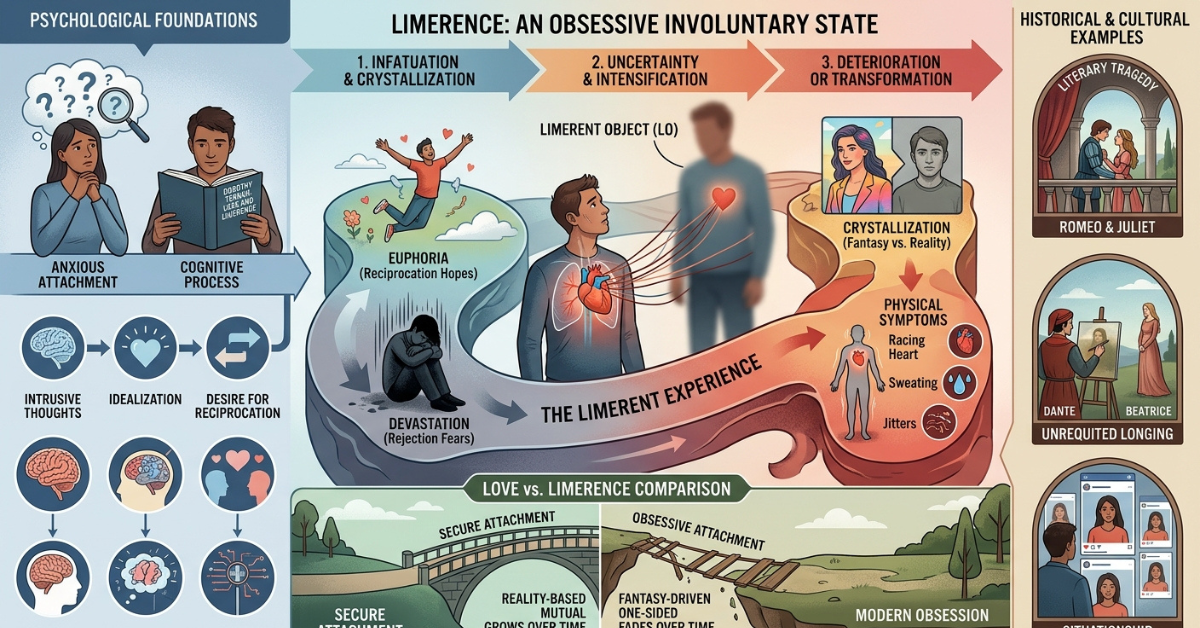
Have you ever liked someone so intensely that they seemed to occupy your thoughts all day? You may constantly replay conversations, wonder whether they feel the same way, and feel unusually happy whenever they give you attention. That intense experience may be more than an ordinary crush—it could be limerence.
So, what is the limerence meaning? In simple terms, limerence is an intense state of romantic or emotional infatuation in which a person becomes highly focused on another individual and strongly desires their feelings to be returned.
The experience can feel exciting, comforting, confusing, and even exhausting at the same time. It is also important to understand that limerence is not simply another word for love. Let’s look at what it means, why it happens, and how it compares with genuine love.
What Is the Limerence Meaning?
The simplest limerence meaning is an intense emotional state characterized by obsessive thoughts about a person and a strong desire for reciprocation.
The term limerence was introduced by psychologist Dorothy Tennov in her 1979 book Love and Limerence. Tennov used the word to describe a particular form of intense romantic infatuation.
Someone experiencing limerence may:
- Think about a particular person repeatedly throughout the day.
- Analyze their texts, facial expressions, or small gestures.
- Feel extremely happy when they receive attention from that person.
- Become anxious when communication is delayed.
- Fantasize about a future relationship.
- Look for signs that their feelings are reciprocated.
- Experience emotional highs and lows based on the person’s behavior.
- Find it difficult to concentrate on other things.
The important part is uncertainty and reciprocation. Limerence often becomes especially powerful when you don’t know exactly how the other person feels.
Limerence Meaning Simple: An Easy Explanation
If you’re looking for the limerence meaning simple, think of it this way:
Limerence is when you become intensely emotionally focused on someone and desperately want them to feel the same way about you.
Imagine meeting someone who immediately captures your attention. You start thinking about them constantly. A simple “good morning” text can make your entire day, while a delayed reply can leave you worrying about what went wrong.
That’s the basic idea behind limerence.
It doesn’t necessarily mean that your feelings are fake. The emotions can be very real and powerful. However, the intensity of limerence doesn’t automatically mean that you’ve found your soulmate or that the relationship is destined to last.
Limerence Meaning Psychology: Why Does It Happen?
From a psychological perspective, limerence involves intense attention, emotional arousal, fantasy, and a strong desire for emotional reciprocation.
One of its most noticeable features is intrusive thinking. You may not intentionally choose to think about the person, but thoughts about them keep appearing anyway.
For example, you might:
- Remember something they said several hours ago.
- Wonder what they meant by it.
- Check whether they’ve viewed your message.
- Imagine different explanations for their behavior.
- Feel relieved when they finally respond.
- Start thinking about them again shortly afterward.
This cycle can make the person feel unusually important in your mind.
The Role of Uncertainty
Uncertainty can be particularly powerful. When someone’s feelings are unclear, your mind may constantly search for clues.
A compliment might feel like evidence that they like you. A short reply might make you question everything. This emotional unpredictability can make the attachment feel even stronger.
That doesn’t mean every uncertain relationship creates limerence. People experience romantic attraction differently, and psychological research does not treat limerence as a formal mental disorder.
Limerence Meaning in Love: Is It the Same as Love?
The phrase limerence meaning in love can be confusing because limerence and love can happen at the same time.
However, they aren’t identical.
Limerence tends to involve:
- Intense attraction
- Intrusive thoughts
- Idealization
- Emotional dependency on another person’s response
- A strong desire for reciprocation
- Fantasy about the relationship
- Sensitivity to signs of rejection
Love, especially mature romantic love, generally involves more than intense attraction. It can include trust, respect, emotional intimacy, commitment, compatibility, care, and acceptance of the other person as they actually are.
In other words, limerence can be intense, while love can be deep.
Limerence Meaning vs Love: What’s the Difference?
The limerence meaning vs love comparison becomes easier when you look at what each experience focuses on.
| Limerence | Love |
| Often centers on intense attraction | Can develop through emotional connection |
| Strong desire for reciprocation | Includes giving and receiving care |
| Can involve idealizing someone | Allows room for imperfections |
| Thoughts may feel intrusive | Connection can feel more grounded |
| Uncertainty may intensify feelings | Trust can become increasingly important |
| Emotional highs and lows may be strong | Often becomes more stable over time |
| May focus heavily on how the person feels about you | Focuses on the well-being of both people |
This doesn’t mean limerence is “bad” and love is automatically “good.” Limerence can be part of the early stages of attraction, and some relationships that begin with intense infatuation eventually develop into deeper love.
The key difference is that love doesn’t depend entirely on the emotional rush of being desired by someone.
Limerence Meaning Example
Here’s a simple limerence meaning example.
Suppose Sarah meets Alex at work. They have a few enjoyable conversations, and Alex compliments her once. Sarah begins thinking about him constantly.
She starts wondering:
“Why did he smile at me like that?”
“Does he like me?”
“Why hasn’t he texted today?”
She checks her phone repeatedly and imagines what their relationship might look like. When Alex sends a friendly message, she feels incredibly happy. When he doesn’t respond, she becomes anxious and starts analyzing everything she said.
Sarah may be experiencing limerence.
Notice that she doesn’t necessarily know Alex very well. Much of the emotional experience is being fueled by hope, uncertainty, imagination, and the desire for reciprocation.
Limerence Meaning in a Relationship
Can limerence happen when you’re already in a relationship?
Yes.
The limerence meaning in relationship contexts can involve becoming intensely preoccupied with a romantic partner—or sometimes with someone outside the relationship.
For example, someone in a long-term relationship might suddenly become intensely attracted to a coworker. They may begin thinking about that person constantly, imagining conversations, comparing their partner with the coworker, or interpreting ordinary interactions as meaningful.
This can create emotional confusion.
Having an intrusive attraction doesn’t automatically make someone a bad partner. What matters is how they respond to those feelings and what boundaries they choose to maintain.
“My Love Is Limerence” Meaning
If someone says “my love is limerence,” they may be questioning whether what they feel is genuine love or intense infatuation.
That question is understandable.
Instead of asking only, “How strongly do I feel?”, it can help to ask:
- Do I know this person realistically, including their flaws?
- Do I care about their well-being even when they aren’t giving me attention?
- Can I respect their boundaries?
- Am I attracted to who they actually are or mostly to an imagined version?
- Does my happiness depend heavily on their responses?
- Can I maintain my normal responsibilities and relationships?
- Am I interested in building something real rather than simply being wanted?
These questions can’t diagnose limerence, but they can help you understand the nature of your feelings.
ADHD Limerence Meaning: Is There a Connection?
People often search for ADHD limerence meaning because intense romantic fixation can sometimes be reported alongside ADHD.
ADHD itself does not mean a person will experience limerence. However, some people with ADHD describe patterns such as hyperfocus, intense interests, emotional sensitivity, and difficulty shifting attention. These experiences may overlap with some features people associate with limerence.
It is important not to turn this overlap into a diagnosis.
If romantic thoughts are interfering significantly with work, sleep, relationships, or everyday functioning, talking with a qualified mental-health professional can be more useful than trying to label the experience yourself.
Autistic Limerence Meaning: What Does It Refer To?
The search term autistic limerence meaning is also becoming more common.
Autistic people can experience romantic attraction, intense interests, attachment, and emotional fixation, just like anyone else. Some autistic individuals may describe unusually strong focus on a person, particularly when that person becomes an important part of their emotional or social world.
However, limerence is not an autism symptom or diagnostic criterion.
It’s better to avoid assuming that intense interest in another person automatically means limerence or that autism automatically causes it. Individual experiences vary considerably.
Platonic Limerence Meaning
Although limerence is usually discussed in a romantic context, some people use the phrase platonic limerence to describe intense emotional preoccupation with someone without wanting a conventional romantic relationship.
The person may:
- Think about a friend constantly.
- Crave their attention or approval.
- Feel unusually anxious when they become distant.
- Analyze their messages and behavior.
- Fantasize about becoming extremely close.
- Feel emotionally dependent on the friendship.
The term “platonic limerence” is commonly used in everyday online discussions, but it isn’t a formal clinical diagnosis.
What Does “In Limerence” Mean?
If someone says, “I’m in limerence,” they mean they’re experiencing the emotional state associated with intense infatuation and preoccupation with another person.
For example:
“I think I’m in limerence because I can’t stop thinking about him.”
Here, “in limerence” describes being caught up in the emotional experience rather than simply having a normal crush.
State of Limerence Meaning
The state of limerence meaning refers to the period during which these intense feelings and thought patterns are present.
It may involve three broad experiences:
1. Attraction
You become strongly interested in someone and feel emotionally drawn toward them.
2. Preoccupation
Your attention repeatedly returns to the person. You may replay interactions, imagine future scenarios, or search for signs of interest.
3. Desire for Reciprocation
You strongly want confirmation that the other person feels the same way.
The intensity can fluctuate. Some people experience limerence for a relatively short period, while for others, it may persist much longer.
Common Signs of Limerence
There is no official checklist that can diagnose limerence, but commonly described experiences include:
- Persistent thoughts about one person
- Idealizing the person
- Constantly checking messages or social media
- Strong sensitivity to their attention
- Fantasizing about being together
- Feeling euphoric after positive interactions
- Feeling distressed after perceived rejection
- Looking for hidden meanings in ordinary behavior
- Difficulty focusing on other activities
- Wanting reassurance about their feelings
Having one or two of these experiences doesn’t necessarily mean you’re experiencing limerence. Romantic attraction naturally involves excitement and frequent thoughts about someone, especially at the beginning.
How Long Does Limerence Last?
There is no universal timeline.
Some people experience intense infatuation for a relatively short period, while others report much longer periods of preoccupation. The duration can depend on the individual, the circumstances of the relationship, whether feelings are reciprocated, and how much uncertainty surrounds the situation.
Limerence may also change over time. It can fade, develop into a more stable relationship, or remain emotionally intense when reciprocation is uncertain.
Can Limerence Turn Into Love?
Yes, it can—but it doesn’t always.
A relationship that begins with intense infatuation may gradually develop into genuine emotional intimacy. As people spend more time together, they usually learn more about each other’s personalities, values, habits, strengths, and weaknesses.
Healthy love tends to become more grounded in reality.
Instead of thinking, “This person is perfect,” you may eventually think, “I know this person’s imperfections, and I still care deeply about them.”
That’s an important shift from idealization toward genuine connection.
How to Deal With Limerence
If intense feelings are becoming distracting or emotionally overwhelming, there are practical steps that may help.
1. Separate Facts From Assumptions
Write down what you actually know versus what you’re imagining.
For example:
Fact: They replied to my message.
Assumption: They replied because they’re secretly in love with me.
This simple distinction can help reduce overinterpretation.
2. Reduce Constant Checking
Repeatedly checking messages, profiles, or online activity can reinforce the cycle of anticipation and anxiety.
Creating some distance can give your attention room to settle.
3. Stay Connected to Your Own Life
Keep investing in:
- Friends and family
- Work or studies
- Exercise
- Hobbies
- Personal goals
- Sleep and daily routines
Your life should remain meaningful outside the person you’re attracted to.
4. Look at the Person Realistically
Ask yourself whether you’re responding to the actual person or an idealized version of them.
Getting to know someone realistically can change how you understand your feelings.
5. Seek Professional Support When Necessary
If obsessive thoughts are causing significant distress or interfering with everyday life, consider speaking with a psychologist or other qualified mental-health professional.
You don’t need to wait until things become unbearable before asking for help.
Is Limerence Bad?
Not necessarily.
Limerence is an emotional experience, not a moral failure. Feeling intensely attracted to someone isn’t inherently unhealthy.
The concern arises when the experience begins controlling your life—for example, when you can’t concentrate, constantly monitor another person, ignore boundaries, neglect responsibilities, or experience severe emotional distress based on their attention.
The goal isn’t necessarily to eliminate every strong feeling. It’s to maintain perspective and make choices that protect your well-being and respect the other person’s boundaries.
Limerence Meaning in English
In everyday English, limerence refers to an intense state of romantic infatuation or emotional preoccupation with someone, especially when you strongly want your feelings to be returned.
It is a relatively specialized word, so someone may understand “crush,” “infatuation,” or “being obsessed with someone” more easily in casual conversation.
However, limerence is more specific than simply having a crush because it emphasizes the intense mental and emotional preoccupation surrounding the person.
Limerence Meaning – AI and Online Definitions
If you’ve searched “limerence meaning -AI” or similar queries, you may have noticed that many online explanations sound almost identical.
The reason is that the core definition is fairly consistent: limerence describes intense infatuation, intrusive thoughts, idealization, and a strong desire for reciprocation.
Still, individual experiences don’t always fit neatly into a definition. A useful explanation should distinguish between ordinary attraction, infatuation, limerence, and mature love rather than treating them as interchangeable terms.
Frequently Asked Questions About Limerence
What is the limerence meaning in simple words?
Limerence is an intense form of infatuation where you become highly focused on someone and strongly want them to return your feelings.
Is limerence the same as love?
No. Limerence and love are different experiences. Limerence often involves intense attraction, uncertainty, fantasy, and a desire for reciprocation. Love can involve deeper qualities such as trust, care, acceptance, intimacy, and commitment.
What is an example of limerence?
A common example is becoming so preoccupied with someone that you constantly think about them, analyze their messages, look for signs that they like you, and experience major emotional highs or lows depending on their attention.
Can you be in limerence without being in love?
Yes. You can experience intense infatuation with someone you don’t know particularly well. Strong feelings alone don’t necessarily mean that a deep, lasting relationship has developed.
Is limerence a mental disorder?
No. Limerence is not recognized as a standalone mental disorder in major diagnostic systems. It is generally used to describe a particular pattern of intense romantic or emotional experience.
What is platonic limerence?
Platonic limerence is an informal term people sometimes use for intense emotional preoccupation with someone without necessarily wanting a romantic relationship.
Does ADHD cause limerence?
ADHD does not automatically cause limerence. However, some people with ADHD report experiences such as intense focus or emotional sensitivity that may overlap with aspects of limerence.
Does autism cause limerence?
Autism does not automatically cause limerence, and limerence is not a diagnostic feature of autism. Some autistic people may nevertheless experience intense emotional attachments or preoccupation with another person.
How do I know if my love is limerence?
Consider whether your feelings involve persistent intrusive thoughts, idealization, intense uncertainty, and a strong dependence on the other person’s attention or reciprocation. These patterns may suggest limerence, but only a qualified professional can assess broader psychological concerns.
Can limerence become healthy love?
It can. Sometimes intense infatuation develops into a stable relationship as two people get to know each other realistically and build trust, intimacy, and mutual commitment. But limerence doesn’t automatically turn into love.
Final Thoughts on Limerence Meaning
Understanding the limerence meaning can make confusing romantic feelings a lot easier to understand. Limerence describes an intense state of infatuation marked by persistent thoughts about someone, idealization, emotional highs and lows, and a strong desire for reciprocation.
It isn’t exactly the same as love, and it isn’t automatically unhealthy. The important question is whether your feelings allow you to remain grounded, respect boundaries, maintain your everyday life, and see the other person realistically.
If you’re wondering whether what you’re experiencing is a crush, infatuation, limerence, or love, give yourself time. Feelings become much clearer when you stop judging their intensity and start paying attention to what those feelings are actually built on.
Leave a comment