

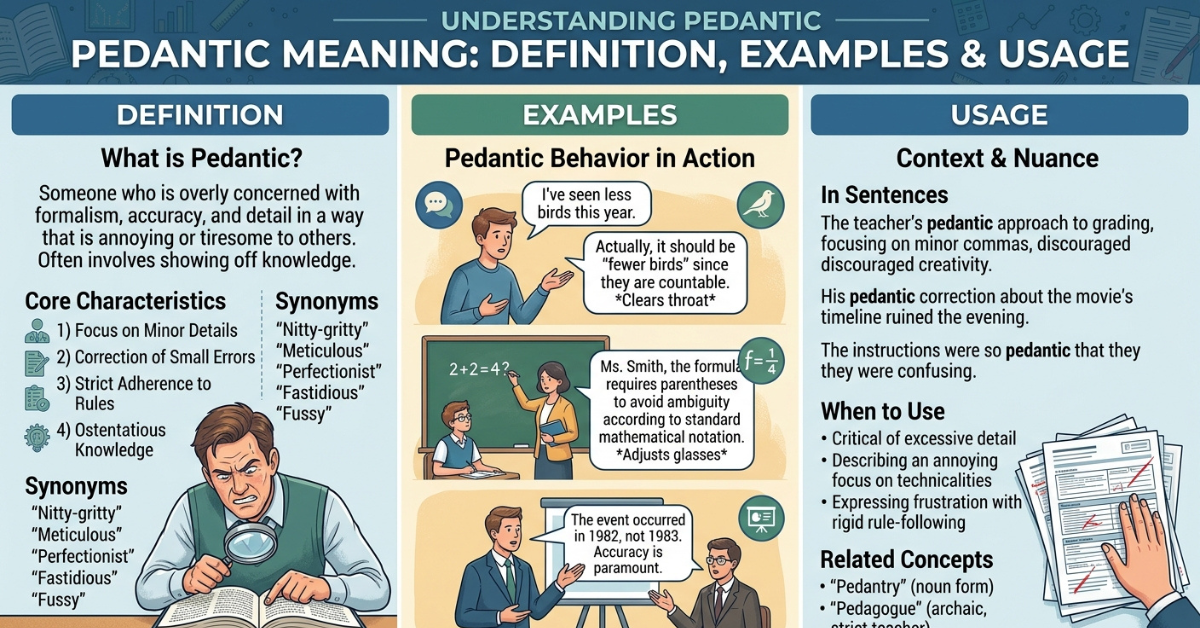
Ever met someone who corrects “less” to “fewer” when everyone already understands what you meant? That person might be described as pedantic.
The pedantic meaning generally refers to being overly concerned with small details, rules, technicalities, or formal correctness, especially when those details are not particularly important to the situation. The word can describe someone’s behavior, writing style, explanation, or way of speaking.
Being precise is not necessarily a bad thing. The word pedantic usually becomes negative when attention to correctness feels excessive, unnecessary, or more focused on showing knowledge than helping others understand.
Pedantic Meaning Definition
According to its common dictionary usage, pedantic means excessively concerned with minor details, rules, or academic correctness.
In simple English, a pedantic person may focus so heavily on being technically correct that they lose sight of the bigger picture.
For example:
“He was being pedantic about the exact wording of the instructions.”
This suggests that the person cared more about the precise wording than the practical meaning of the instructions.
Pedantic Meaning in English
The pedantic meaning in English can be understood as:
Overly focused on rules, details, technical correctness, or formal knowledge.
A person who carefully explains an important distinction because it genuinely matters is simply being precise. Someone who repeatedly corrects insignificant details, particularly when nobody asked for the correction, may be called pedantic.
What Does Pedantic Mean as a Person?
When people search for pedantic meaning person, they are usually asking what a “pedantic person” is like.
A pedantic person may:
- Correct other people’s grammar unnecessarily.
- Insist on technically precise wording.
- Focus on tiny factual differences.
- Quote rules even when they are not relevant.
- Give excessively detailed explanations.
- Care more about technical correctness than practical communication.
For example, if someone says, “I waited forever,” and another person responds, “You didn’t literally wait forever,” the second person could be described as pedantic if the correction is unnecessary.
Pedantic Meaning With Example
Here are some everyday examples to make the meaning clearer:
- Grammar:
“She was being pedantic about my use of punctuation.” - Conversation:
“Don’t be pedantic; you know what I meant.” - Academic discussion:
“His answer was accurate but sounded pedantic because he focused on minor technicalities.” - Rules:
“The manager’s pedantic interpretation of the policy frustrated the employees.” - Writing:
“The article became too pedantic and difficult for ordinary readers to follow.”
These examples show an important point: pedantic usually describes how someone handles information, rather than simply saying that the person is intelligent or knowledgeable.
Is Pedantic an Insult?
It can be.
Calling someone pedantic often carries a negative meaning because it suggests that the person is unnecessarily fussy about details or correctness.
However, the strength of the criticism depends on context. Someone might jokingly say:
“Okay, okay, don’t get pedantic!”
In this situation, it may simply mean, “You’re taking this technicality too seriously.”
In a professional or academic setting, the word can be more serious and may criticize someone’s communication style.
Pedantic Meaning Slang
There is no completely separate modern pedantic meaning slang. In casual speech, however, pedantic is often used more loosely to describe someone who is being annoyingly precise or overly technical.
For example:
“Bro, you’re being so pedantic right now.”
Here, the speaker probably means that the other person is focusing on a tiny technical detail instead of the main point.
Online discussions, social media arguments, and comment sections often use pedantic this way.
Shallow and Pedantic Meaning
The expressions shallow and pedantic describe different weaknesses.
Shallow usually means lacking depth, thought, or understanding. A shallow argument may deal only with surface-level ideas.
Pedantic, on the other hand, describes excessive attention to technical details, rules, or minor points.
Someone can actually be both shallow and pedantic. For instance, a person might know many small technical facts but fail to understand the deeper meaning of a subject.
Shallow vs. Pedantic
| Word | Basic meaning |
| Shallow | Lacking depth or deeper understanding |
| Pedantic | Excessively concerned with details or technical correctness |
| Precise | Accurate and exact, usually in a useful way |
| Fussy | Overly concerned with small matters |
| Academic | Related to education, scholarship, or theoretical study |
Pedantic Meaning Psychology
From a psychological perspective, pedantic is primarily a descriptive adjective, not a standalone psychological diagnosis.
Pedantic behavior can sometimes appear as part of a person’s communication style or personality. Someone may have a strong preference for rules, structure, precision, or factual accuracy.
However, it would be misleading to assume that every pedantic person has a particular psychological condition. Being detail-oriented or highly precise by itself does not indicate a disorder.
In some contexts, clinicians may use terms such as pedantic speech when describing unusually formal, overly detailed, or circumstantial communication. The meaning depends heavily on the specific clinical context.
Didactic vs. Pedantic Meaning
The difference between didactic and pedantic meaning is easy to miss because both words can relate to teaching or explaining information.
Didactic means intended to teach or instruct. It can be neutral or positive, although it may sometimes suggest that something is overly instructional or moralizing.
Pedantic means excessively concerned with minor details, formal rules, or technical correctness.
For example:
- Didactic: “The book has a didactic purpose—it teaches children about environmental protection.”
- Pedantic: “The speaker’s explanation became pedantic because he spent ten minutes correcting a minor technicality.”
Didactic vs. Pedantic: Quick Difference
Didactic = focused on teaching.
Pedantic = excessively focused on technical correctness or details.
A teacher can be didactic without being pedantic, and a pedantic person may not be trying to teach anyone at all.
Pedantic Meaning in Different Languages
The word pedantic is translated differently depending on the language and context. The closest translation may describe someone as overly particular, excessively academic, or unnecessarily concerned with details.
Pedantic Meaning in Urdu
The pedantic meaning in Urdu can be expressed as:
- بلا ضرورت باریک بینی کرنے والا
- چھوٹی چھوٹی باتوں میں ضرورت سے زیادہ پڑنے والا
- تعلیمی یا فنی باتوں میں حد سے زیادہ الجھنے والا
In everyday Urdu, the exact wording can change depending on whether you are describing someone’s speech, behavior, or attitude.
Pedantic Meaning in Hindi
The pedantic meaning in Hindi can be understood as:
- बारीकियों पर जरूरत से ज्यादा जोर देने वाला
- नियमों या तकनीकी बातों को लेकर अत्यधिक सख्त
- छोटी-छोटी बातों में अनावश्यक रूप से उलझने वाला
For example, a person who keeps correcting insignificant details during a casual conversation may be called pedantic.
Pedantic Meaning in Farsi
The pedantic meaning in Farsi (Persian) can be conveyed with expressions such as:
- مُدَقّق و بیش از حد سختگیر در جزئیات
- کسی که بیش از حد به جزئیات و قواعد توجه میکند
The best translation depends on the context, because pedantic can imply unnecessary formality as well as excessive attention to technical details.
Pedantic Meaning in Marathi
In Marathi, the idea behind pedantic can be expressed as:
छोट्या-छोट्या तपशीलांवर किंवा नियमांवर गरजेपेक्षा जास्त भर देणारा.
In other words, someone who gives excessive importance to minor details or technical rules.
Pedantic Meaning in Bengali
In Bengali, pedantic can be explained as:
ছোটখাটো বিষয়, নিয়ম বা খুঁটিনাটির প্রতি প্রয়োজনের চেয়ে বেশি গুরুত্ব দেওয়া।
It can describe someone who is unnecessarily particular about technical correctness.
Pedantic Meaning in Tamil
In Tamil, the concept can be expressed as:
சிறிய விவரங்கள் அல்லது விதிகளுக்கு தேவைக்கு அதிகமாக முக்கியத்துவம் கொடுப்பவர்.
The exact translation may vary depending on whether the word is being used to describe speech, writing, or behavior.
Pedantic Meaning in Kannada
In Kannada, pedantic can be explained as:
ಸಣ್ಣ ವಿವರಗಳು ಅಥವಾ ನಿಯಮಗಳ ಬಗ್ಗೆ ಅಗತ್ಯಕ್ಕಿಂತ ಹೆಚ್ಚು ಒತ್ತು ನೀಡುವ ವ್ಯಕ್ತಿ.
It generally conveys the idea of being excessively particular about details or formal correctness.
Pedantic Meaning in Malayalam
In Malayalam, the meaning can be expressed as:
ചെറിയ കാര്യങ്ങളിലോ നിയമങ്ങളിലോ ആവശ്യത്തിലധികം ശ്രദ്ധ ചെലുത്തുന്ന വ്യക്തി.
It can refer to someone who is unnecessarily strict about technical details or rules.
Pedantic Meaning in a Sentence
Here are a few natural sentences using the word:
- “There’s no need to be pedantic; everyone understood the point.”
- “His pedantic approach made a simple explanation much longer.”
- “She gave a useful answer without sounding pedantic.”
- “The professor was knowledgeable but sometimes became pedantic.”
- “He made a pedantic correction that wasn’t relevant to the discussion.”
Notice that pedantic usually appears when the speaker thinks the attention to detail has gone too far.
Synonyms for Pedantic
Depending on the context, possible synonyms include:
- Overly precise
- Fussy
- Nitpicky
- Finicky
- Hair-splitting
- Picky
- Overly technical
- Formalistic
- Scholastic
These words are not perfect replacements in every sentence. For example, nitpicky is more informal, while pedantic can sound more academic or sophisticated.
Antonyms of Pedantic
Some useful opposites include:
- Flexible
- Practical
- Broad-minded
- Relaxed
- Informal
- Easygoing
- Big-picture
- Pragmatic
Again, the best antonym depends on what aspect of pedantic you mean.
Pedantic vs. Precise: What’s the Difference?
This is one of the most important distinctions.
Being precise is usually a positive quality. It means communicating accurately and avoiding ambiguity when accuracy matters.
Being pedantic suggests that precision has become excessive or misplaced.
Consider two examples:
Precise:
“The recipe requires 250 grams of flour, so measure it carefully.”
Pedantic:
“You said ‘a cup of flour,’ but technically a cup can vary depending on how it is measured, so your statement is scientifically imprecise.”
The second statement might be factually correct, but the correction may not be useful in the situation.
Why Do People Use the Word Pedantic?
People often use pedantic when they feel that someone is:
- Missing the main point.
- Correcting an insignificant detail.
- Making a simple discussion unnecessarily complicated.
- Using technical language when simpler language would work.
- Prioritizing being right over being helpful.
That’s why the word often appears during disagreements.
Is Being Pedantic Always Bad?
Not necessarily.
Attention to detail is extremely valuable in fields where accuracy matters. Scientists, editors, engineers, lawyers, programmers, researchers, and medical professionals may need to distinguish between very small differences.
The problem is usually context.
Being extremely precise while checking a legal contract can be useful. Being extremely precise when someone casually tells you they “waited forever” may simply be annoying.
A good rule is:
Precision is useful when the detail matters; pedantry is often what happens when the detail doesn’t.
How to Avoid Sounding Pedantic
If you want to communicate accurately without coming across as pedantic, try these approaches:
- Focus on the main idea before minor details.
- Correct people only when the correction is useful.
- Use simple language when technical terms are unnecessary.
- Ask whether someone wants a detailed explanation.
- Avoid turning every casual statement into a factual debate.
- Consider the purpose and audience of the conversation.
The goal isn’t to stop being knowledgeable. It’s to know when your knowledge actually helps.
Frequently Asked Questions About Pedantic Meaning
What is the simple meaning of pedantic?
Pedantic means being overly concerned with small details, rules, technicalities, or formal correctness, especially when that level of precision is unnecessary.
What does pedantic mean in slang?
In casual slang-like usage, pedantic usually means someone is being annoyingly precise, picky, or focused on a tiny technical detail.
Is pedantic positive or negative?
It is usually negative or mildly critical. However, the word can sometimes be used humorously, and being highly precise can be useful in situations where accuracy genuinely matters.
What is a pedantic person?
A pedantic person is someone who tends to focus excessively on technical details, rules, academic distinctions, or exact wording.
What is an example of pedantic behavior?
Correcting someone who says “I waited forever” by insisting that they obviously did not wait for an infinite amount of time could be considered pedantic, because the literal correction is irrelevant to the intended meaning.
What is the difference between pedantic and didactic?
Didactic relates to teaching or instruction, while pedantic describes excessive concern with technical details, rules, or correctness.
What is the difference between pedantic and precise?
Precise generally means accurate and exact in a useful way. Pedantic suggests being excessively or unnecessarily concerned with that accuracy.
Is pedantic the same as intelligent?
No. A pedantic person may be knowledgeable, but pedantic describes a person’s approach to details or communication, not their intelligence.
What does pedantic mean in psychology?
In psychology and clinical descriptions, pedantic can describe communication that is unusually formal, overly detailed, or excessively focused on technical distinctions. It is not, by itself, a psychological diagnosis.
What is the opposite of pedantic?
Depending on the context, possible opposites include practical, flexible, relaxed, informal, and big-picture.
Conclusion: Understanding the Pedantic Meaning
The pedantic meaning is easier to understand when you think about the difference between useful precision and unnecessary precision. A pedantic person tends to focus heavily on minor details, technicalities, rules, or exact wording, even when those details do not add much value to the conversation.
The word is usually mildly negative, but being detail-oriented isn’t inherently bad. In fact, precision is essential in many professional and academic situations. The key is knowing when accuracy helps and when it simply distracts from the bigger picture.
If you’re learning English vocabulary, understanding words like pedantic, didactic, precise, nitpicky, and fussy can help you express subtle differences in people’s behavior and communication.
Leave a comment